Ch.5 - Periodicity & Electronic Structure of Atoms
McMurry - Chemistry 8th Edition
McMurry8th EditionChemistryISBN: 9781292336145Non è quello che usi tu?Cambia libro di testo
Capitolo 5, Problema 118

Why do atomic radii increase going down a group of the periodic table?

Guida verificata passo dopo passo
1
Step 1: Understand that atomic radius is the distance from the nucleus of an atom to the outermost electron shell.
Step 2: Recognize that as you move down a group in the periodic table, each element has an additional electron shell compared to the one above it.
Step 3: Note that with each additional electron shell, the outermost electrons are further from the nucleus, increasing the atomic radius.
Step 4: Consider the effect of electron shielding, where inner electron shells partially block the attraction between the nucleus and the outermost electrons, allowing the atomic radius to increase.
Step 5: Conclude that the combination of additional electron shells and increased electron shielding results in a larger atomic radius as you move down a group.

Concetti chiave

Ecco i concetti essenziali che devi comprendere per rispondere correttamente alla domanda.

Atomic Radius

The atomic radius is defined as the distance from the nucleus of an atom to the outermost shell of electrons. It is a measure of the size of an atom and can vary depending on the atom's environment and bonding. Understanding atomic radius is crucial for analyzing trends in the periodic table.
Video consigliato:

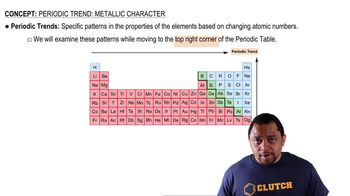
Periodic Trends

Periodic trends refer to the predictable patterns observed in the properties of elements as one moves across or down the periodic table. These trends include atomic radius, ionization energy, and electronegativity. Recognizing these trends helps explain why atomic radii increase down a group due to the addition of electron shells.
Video consigliato:
Percorso guidato
00:38
Periodic Trends

Electron Shielding

Electron shielding occurs when inner-shell electrons repel outer-shell electrons, reducing the effective nuclear charge felt by the outer electrons. As you move down a group, additional electron shells are added, increasing shielding and allowing outer electrons to be further from the nucleus, which contributes to the increase in atomic radius.
Video consigliato:
Percorso guidato
04:44
Electron Geometry