Ch.9 - Periodic Properties of the Elements
Tro - Chemistry: A Molecular Approach 5th Edition
Tro5th EditionChemistry: A Molecular ApproachISBN: 9780134874371Non è quello che usi tu?Cambia libro di testo
Capitolo 9, Problema 64a

Write the electron configuration for each ion. a. Cl-

Guida verificata passo dopo passo
1
Step 1: Identify the atomic number of the neutral atom. The atomic number of Chlorine (Cl) is 17, which means a neutral chlorine atom has 17 electrons.
Step 2: Determine the charge of the ion. In this case, the ion is Cl-, which means it has gained one electron.
Step 3: Add the number of gained or subtract the number of lost electrons from the atomic number to find the total number of electrons in the ion. Since Cl- has gained one electron, it has 18 electrons in total.
Step 4: Write the electron configuration for the neutral atom first. The electron configuration of a neutral chlorine atom (17 electrons) is 1s2 2s2 2p6 3s2 3p5.
Step 5: Add the extra electron to the highest energy level (n=3). The electron configuration of Cl- is 1s2 2s2 2p6 3s2 3p6.

Risposta video verificata per un problema simile:

Questa soluzione video è stata consigliata dai nostri tutor come utile per risolvere questo problema.
Durata del video:
3m

Concetti chiave

Ecco i concetti essenziali che devi comprendere per rispondere correttamente alla domanda.

Electron Configuration

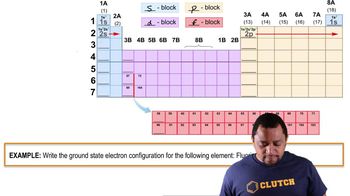
Electron configuration describes the distribution of electrons in an atom or ion's orbitals. It is represented using a notation that indicates the energy levels and sublevels occupied by electrons. For example, the electron configuration of a neutral chlorine atom (Cl) is 1s² 2s² 2p⁶ 3s² 3p⁵, which shows how electrons are arranged in various energy levels.
Video consigliato:
Percorso guidato
01:33
Electron Configuration Example

Ionic Charge

Ionic charge refers to the electrical charge that an atom or molecule acquires when it gains or loses electrons. Anions, like Cl⁻, are negatively charged ions formed when an atom gains one or more electrons. This additional electron alters the electron configuration, resulting in a more stable arrangement, often resembling that of the nearest noble gas.
Video consigliato:

Noble Gas Configuration

Noble gas configuration is a shorthand notation for electron configurations that highlights the stability of noble gases, which have full outer electron shells. For chlorine, gaining an electron to form Cl⁻ results in the electron configuration resembling that of argon (Ar), which is 1s² 2s² 2p⁶ 3s² 3p⁶. This configuration indicates a stable, filled outer shell.
Video consigliato:
Percorso guidato
00:59
Noble Gas Compounds