Ch.9 - Periodic Properties of the Elements
Tro - Chemistry: A Molecular Approach 5th Edition
Tro5th EditionChemistry: A Molecular ApproachISBN: 9780134874371Non è quello che usi tu?Cambia libro di testo
Capitolo 9, Problema 64d,e

Write the electron configuration for each ion. d. Mo3+ e. V3+

Guida verificata passo dopo passo
1
Identify the atomic number of molybdenum (Mo), which is 42.
Write the electron configuration for a neutral Mo atom: [Kr] 4d^5 5s^1.
When forming a Mo^{3+} ion, remove three electrons from the neutral atom configuration.
Electrons are removed first from the outermost shell, which is the 5s orbital, and then from the 4d orbital.
Remove one electron from the 5s orbital and two electrons from the 4d orbital to get the electron configuration for Mo^{3+}.

Risposta video verificata per un problema simile:

Questa soluzione video è stata consigliata dai nostri tutor come utile per risolvere questo problema.
Durata del video:
4m

Concetti chiave

Ecco i concetti essenziali che devi comprendere per rispondere correttamente alla domanda.

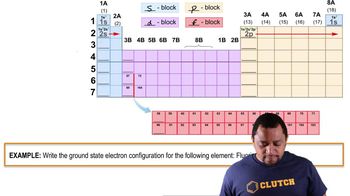
Electron Configuration

Electron configuration describes the distribution of electrons in an atom or ion's atomic orbitals. It is represented using a notation that indicates the energy levels and sublevels occupied by electrons, following the Aufbau principle, Pauli exclusion principle, and Hund's rule. Understanding electron configuration is essential for predicting chemical behavior and bonding properties.
Video consigliato:
Percorso guidato
01:33
Electron Configuration Example

Transition Metals

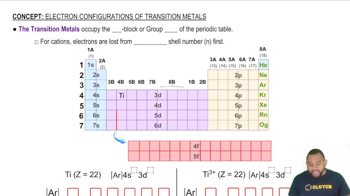
Transition metals are elements found in the d-block of the periodic table, characterized by their ability to form variable oxidation states and colored compounds. They have partially filled d orbitals, which play a crucial role in their chemical reactivity and the formation of complex ions. Knowing the properties of transition metals helps in understanding their electron configurations and the implications for ion formation.
Video consigliato:
Percorso guidato
03:12
Transition Metals

Ion Formation and Charge

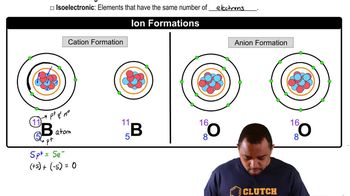
Ion formation occurs when an atom gains or loses electrons, resulting in a charged particle. The charge of an ion indicates the number of electrons lost or gained; for example, Mo^3+ means the molybdenum atom has lost three electrons. This change in electron count directly affects the electron configuration, as the configuration must be adjusted to reflect the new number of electrons present in the ion.
Video consigliato: