Ch.9 - Periodic Properties of the Elements
Tro - Chemistry: A Molecular Approach 5th Edition
Tro5th EditionChemistry: A Molecular ApproachISBN: 9780134874371Non è quello che usi tu?Cambia libro di testo
Capitolo 9, Problema 64c

Write the electron configuration for each ion. c. K+

Guida verificata passo dopo passo
1
Identify the electron configuration of the neutral potassium (K) atom. Potassium has an atomic number of 19, so its electron configuration is \(1s^2 2s^2 2p^6 3s^2 3p^6 4s^1\).
Recognize that \(K^+\) is a potassium ion that has lost one electron.
Remove one electron from the outermost shell of the neutral potassium atom to account for the positive charge.
The electron removed will be from the 4s orbital, as it is the highest energy level in the neutral potassium atom.
Write the electron configuration for \(K^+\) as \(1s^2 2s^2 2p^6 3s^2 3p^6\), which is the same as the electron configuration of argon (Ar), a noble gas.

Risposta video verificata per un problema simile:

Questa soluzione video è stata consigliata dai nostri tutor come utile per risolvere questo problema.
Durata del video:
4m

Concetti chiave

Ecco i concetti essenziali che devi comprendere per rispondere correttamente alla domanda.

Electron Configuration

Electron configuration describes the distribution of electrons in an atom or ion's orbitals. It is represented using a notation that indicates the energy levels and sublevels occupied by electrons, following the Aufbau principle, Pauli exclusion principle, and Hund's rule. Understanding electron configuration is essential for predicting chemical behavior and bonding properties.
Video consigliato:
Percorso guidato
01:33
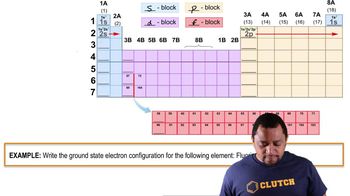
Electron Configuration Example

Ionic Charge

Ionic charge refers to the electrical charge that an atom or ion carries due to the loss or gain of electrons. For example, a potassium ion (K<sup>+</sup>) has a +1 charge, indicating it has lost one electron compared to its neutral state. This change in electron count directly affects the electron configuration, as the configuration must reflect the new number of electrons.
Video consigliato:

Potassium Ion (K<sup>+</sup>)

Potassium (K) is an alkali metal with an atomic number of 19, meaning it has 19 electrons in its neutral state. When it forms a K<sup>+</sup> ion, it loses one electron, resulting in a total of 18 electrons. The electron configuration for K<sup>+</sup> is thus 1s² 2s² 2p⁶ 3s², which can be simplified to [Ar] to denote the configuration of the nearest noble gas, argon.
Video consigliato:
Percorso guidato
02:33
Magnitude of Equilibrium Constant