Ch.9 - Periodic Properties of the Elements
Tro - Chemistry: A Molecular Approach 5th Edition
Tro5th EditionChemistry: A Molecular ApproachISBN: 9780134874371Non è quello che usi tu?Cambia libro di testo
Capitolo 9, Problema 64b

Write the electron configuration for each ion. b. P3-

Guida verificata passo dopo passo
1
Identify the atomic number of phosphorus (P), which is 15, indicating it has 15 electrons in its neutral state.
Determine the electron configuration for a neutral phosphorus atom: 1s^2 2s^2 2p^6 3s^2 3p^3.
Recognize that the P^{3-} ion has gained 3 additional electrons, resulting in a total of 18 electrons.
Write the electron configuration for the P^{3-} ion, which will be the same as the electron configuration for argon (Ar) since it has 18 electrons: 1s^2 2s^2 2p^6 3s^2 3p^6.
Verify that the electron configuration for P^{3-} is complete and matches the noble gas configuration of argon.

Risposta video verificata per un problema simile:

Questa soluzione video è stata consigliata dai nostri tutor come utile per risolvere questo problema.
Durata del video:
2m

Concetti chiave

Ecco i concetti essenziali che devi comprendere per rispondere correttamente alla domanda.

Electron Configuration

Electron configuration describes the distribution of electrons in an atom or ion across various energy levels and orbitals. It is typically represented using a notation that indicates the number of electrons in each subshell, such as 1s² 2s² 2p⁶. Understanding electron configuration is essential for predicting chemical behavior and bonding properties.
Video consigliato:
Percorso guidato
01:33
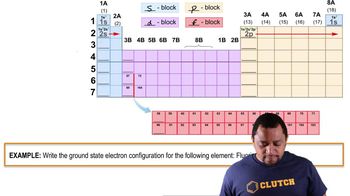
Electron Configuration Example

Ionic Charge

Ionic charge refers to the electrical charge that an atom or ion carries due to the loss or gain of electrons. For example, a phosphorus atom (P) typically has five valence electrons. When it gains three electrons to form the P³⁻ ion, it achieves a full outer shell, resulting in a negative charge of three. This concept is crucial for determining the electron configuration of ions.
Video consigliato:

Valence Electrons

Valence electrons are the outermost electrons of an atom and are involved in chemical bonding. The number of valence electrons determines an element's reactivity and the types of bonds it can form. For phosphorus, which is in group 15 of the periodic table, there are five valence electrons, and understanding this helps in predicting the electron configuration of its ions, such as P³⁻.
Video consigliato:
Percorso guidato
02:12
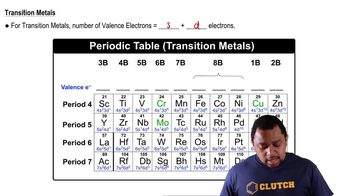
Transition Metals Valence Electrons