Ch. 10 - DNA Replication
Klug - Essentials of Genetics 10th Edition
Klug10th EditionEssentials of GeneticsISBN: 9780135588789Non è quello che usi tu?Cambia libro di testo
Capitolo 10, Problema 10

Kornberg showed that nucleotides are added to the 3' end of each growing DNA strand. In what way does an exposed 3'-OH group participate in strand elongation?

Guida verificata passo dopo passo
1
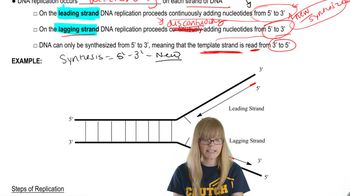
Understand that DNA strand elongation occurs by adding nucleotides to the 3' end of the growing strand, which means the 3'-OH group is crucial for this process.
Recognize that the 3'-OH group acts as a nucleophile, meaning it donates an electron pair to form a new chemical bond during DNA synthesis.
During strand elongation, the 3'-OH group attacks the incoming nucleotide's 5'-phosphate group, facilitating the formation of a phosphodiester bond.
This phosphodiester bond links the 3' carbon of the existing nucleotide to the 5' carbon of the new nucleotide, extending the DNA strand in the 5' to 3' direction.
Therefore, the exposed 3'-OH group is essential because it provides the reactive site that allows DNA polymerase to add new nucleotides and elongate the DNA strand.

Risposta video verificata per un problema simile:

Questa soluzione video è stata consigliata dai nostri tutor come utile per risolvere questo problema.
Durata del video:
2m

Concetti chiave

Ecco i concetti essenziali che devi comprendere per rispondere correttamente alla domanda.

DNA Strand Elongation Directionality

DNA synthesis occurs in the 5' to 3' direction, meaning nucleotides are added to the 3' end of the growing strand. This directionality is crucial because DNA polymerase can only add nucleotides to a free 3'-OH group, ensuring proper strand growth.
Video consigliato:

Role of the 3'-OH Group in DNA Polymerization

The exposed 3'-OH group acts as a nucleophile that attacks the incoming nucleotide's 5'-phosphate group, forming a phosphodiester bond. This chemical reaction links nucleotides together, enabling the elongation of the DNA strand.
Video consigliato:

Function of DNA Polymerase in Strand Elongation

DNA polymerase catalyzes the addition of nucleotides to the 3' end by facilitating the formation of phosphodiester bonds between the 3'-OH of the growing strand and the 5'-phosphate of the incoming nucleotide. This enzyme ensures high fidelity and processivity during DNA replication.
Video consigliato:
Percorso guidato
08:26
Functional Genomics