Ch. 13 - Translation and Proteins
Klug - Essentials of Genetics 10th Edition
Klug10th EditionEssentials of GeneticsISBN: 9780135588789Non è quello che usi tu?Cambia libro di testo
Capitolo 13, Problema 9

What are the major differences between translation in bacteria and translation in eukaryotes?

Guida verificata passo dopo passo
1
Identify the key stages of translation common to both bacteria and eukaryotes: initiation, elongation, and termination.
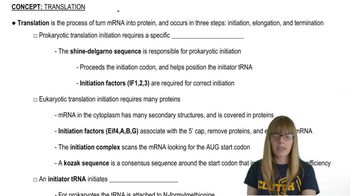
Examine the initiation process differences, focusing on the ribosome subunits involved (70S in bacteria vs. 80S in eukaryotes) and the role of the Shine-Dalgarno sequence in bacteria compared to the 5' cap recognition in eukaryotes.
Compare the initiator tRNA molecules: in bacteria, the initiator tRNA carries formyl-methionine (fMet), whereas in eukaryotes, it carries methionine (Met) without formylation.
Discuss the differences in initiation factors: bacteria use IF1, IF2, and IF3, while eukaryotes have a more complex set of initiation factors (eIFs) that assist in ribosome assembly and mRNA recognition.
Highlight differences in the location and timing of translation: bacterial translation can begin while transcription is still ongoing (coupled transcription-translation), whereas in eukaryotes, translation occurs in the cytoplasm after mRNA processing and export from the nucleus.

Concetti chiave

Ecco i concetti essenziali che devi comprendere per rispondere correttamente alla domanda.

Initiation of Translation

In bacteria, translation initiation involves the recognition of the Shine-Dalgarno sequence on mRNA by the small ribosomal subunit, positioning it for start codon recognition. In eukaryotes, the small ribosomal subunit binds to the 5' cap of mRNA and scans downstream to find the start codon, reflecting differences in mRNA structure and initiation mechanisms.
Video consigliato:
Percorso guidato
07:58
Translation initiation

Ribosome Structure and Size

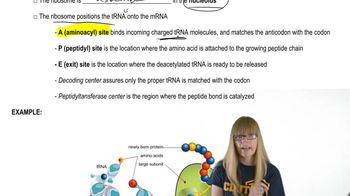
Bacterial ribosomes are 70S, composed of 50S and 30S subunits, while eukaryotic ribosomes are larger 80S particles made of 60S and 40S subunits. This structural difference affects translation dynamics and the interaction with various translation factors.
Video consigliato:
Percorso guidato
03:49
Ribosome Structure

Coupling of Transcription and Translation

In bacteria, transcription and translation are coupled, meaning translation can begin on mRNA while it is still being synthesized. In eukaryotes, these processes are separated spatially and temporally, with transcription occurring in the nucleus and translation in the cytoplasm, allowing for additional mRNA processing steps.
Video consigliato:
Percorso guidato
07:58
Translation initiation