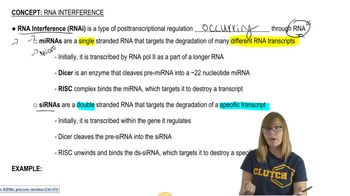
RNAi may be directed by small interfering RNAs (siRNAs) or microRNAs (miRNAs); how are these similar, and how are they different?
Ch. 18 - Post-transcriptional Regulation in Eukaryotes

Klug12th EditionConcepts of GeneticsISBN: 9780135564776Non è quello che usi tu?Cambia libro di testo
Tutti i libri di testo
Klug 12th Edition
Ch. 18 - Post-transcriptional Regulation in Eukaryotes
Problema 16
Klug 12th Edition
Ch. 18 - Post-transcriptional Regulation in Eukaryotes
Problema 16Capitolo 18, Problema 16
Competing endogenous RNAs act as molecular 'sponges.' What does this mean, and what do they compete with?
Guida verificata passo dopo passo1
Understand that competing endogenous RNAs (ceRNAs) are RNA molecules that regulate gene expression by binding to microRNAs (miRNAs), which are small non-coding RNAs involved in gene silencing.
Recognize that miRNAs typically bind to messenger RNAs (mRNAs) to inhibit their translation or promote their degradation, thus reducing protein production.
Learn that ceRNAs act as molecular 'sponges' by containing binding sites for specific miRNAs, effectively sequestering these miRNAs and preventing them from binding to their target mRNAs.
Identify that the competition is between ceRNAs and mRNAs for binding to the same pool of miRNAs; by 'soaking up' miRNAs, ceRNAs reduce the miRNA-mediated repression of mRNAs.
Conclude that this mechanism allows ceRNAs to indirectly regulate gene expression by modulating the availability of miRNAs to their target mRNAs.

Risposta video verificata per un problema simile:
Questa soluzione video è stata consigliata dai nostri tutor come utile per risolvere questo problema.
Durata del video:
55sConcetti chiave
Ecco i concetti essenziali che devi comprendere per rispondere correttamente alla domanda.
Competing Endogenous RNAs (ceRNAs)
Competing endogenous RNAs are RNA molecules that regulate gene expression by binding and sequestering microRNAs (miRNAs). By acting as molecular 'sponges,' they reduce the availability of miRNAs to bind their usual target mRNAs, thus influencing the expression of those genes.
Video consigliato:
MicroRNAs (miRNAs)
MicroRNAs are small non-coding RNAs that regulate gene expression post-transcriptionally by binding to complementary sequences on target mRNAs, leading to mRNA degradation or translational repression. Their activity is modulated by interactions with ceRNAs.
Video consigliato:
Percorso guidato
RNA Interference
Molecular 'Sponge' Mechanism
The 'sponge' mechanism refers to ceRNAs competing with mRNAs for binding to shared miRNAs. By sequestering miRNAs, ceRNAs prevent them from repressing target mRNAs, thereby indirectly increasing the expression of those genes.
Video consigliato:
Percorso guidato
Mapping with Markers
Pratica correlata
Domanda del libro di testo
977
views
Domanda del libro di testo
How and why are eukaryotic mRNAs transported and localized to discrete regions of the cell?
463
views
Domanda del libro di testo
In principle, RNAi may be used to fight viral infection. How might this work?
544
views
Domanda del libro di testo
miRNAs target endogenous mRNAs in a sequence-specific manner. Explain, conceptually, how one might identify potential mRNA targets for a given miRNA if you only know the sequence of the miRNA and the sequence of all mRNAs in a cell or tissue of interest.
749
views
Domanda del libro di testo
How are mRNAs stored within the cell in a translationally inactive state, and how can their translation be stimulated?
556
views
Domanda del libro di testo
While circular RNAs were first described long ago, they have only recently been investigated for function. What are their known and suspected functions in the cell?
462
views