Domanda del libro di testo
Competing endogenous RNAs act as molecular 'sponges.' What does this mean, and what do they compete with?
564
views

 Klug 12th EditionCh. 18 - Post-transcriptional Regulation in EukaryotesProblema 15
 Guida verificata passo dopo passo
 06:59
06:59
 04:15
04:15Competing endogenous RNAs act as molecular 'sponges.' What does this mean, and what do they compete with?
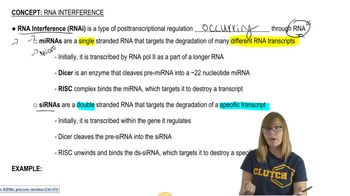
RNAi may be directed by small interfering RNAs (siRNAs) or microRNAs (miRNAs); how are these similar, and how are they different?
miRNAs target endogenous mRNAs in a sequence-specific manner. Explain, conceptually, how one might identify potential mRNA targets for a given miRNA if you only know the sequence of the miRNA and the sequence of all mRNAs in a cell or tissue of interest.
Present an overview of RNA interference (RNAi). How does the silencing process begin, and what major components participate?
How are mRNAs stored within the cell in a translationally inactive state, and how can their translation be stimulated?
While circular RNAs were first described long ago, they have only recently been investigated for function. What are their known and suspected functions in the cell?