Ch. 11 - Gene Mutation, DNA Repair, and Homologous Recombination
Sanders - Genetic Analysis: An Integrated Approach 3rd Edition
Sanders3rd EditionGenetic Analysis: An Integrated ApproachISBN: 9780135564172Non è quello che usi tu?Cambia libro di testo
Capitolo 11, Problema 41a

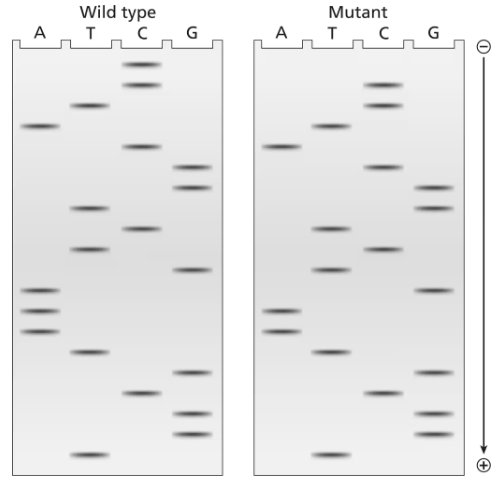
The two gels illustrated contain dideoxynucleotide DNA-sequencing information for a wild-type segment and mutant segment of DNA corresponding to the N-terminal end of a protein. The start codon and the next five codons are sequenced.
DNA sequencing gels showing wild-type and mutant segments with labeled bases A, T, C, G and strand polarity indicators.
Write the DNA sequence of both alleles, including strand polarity.

Guida verificata passo dopo passo
1
Examine the gel images provided for both the wild-type and mutant DNA segments. Identify the bands corresponding to each nucleotide in the sequencing lanes (A, T, G, C). These bands represent the sequence of the DNA strand being analyzed.
Determine the sequence of the wild-type DNA strand by reading the bands from bottom to top (smallest fragment to largest fragment) in the gel. This represents the 5' to 3' polarity of the DNA strand.
Repeat the process for the mutant DNA strand, again reading the bands from bottom to top to determine the sequence and strand polarity.
Compare the sequences of the wild-type and mutant DNA strands. Identify any differences in the nucleotide sequence between the two alleles, which may correspond to mutations.
Write the DNA sequences for both the wild-type and mutant alleles, ensuring you include the strand polarity (5' to 3'). Clearly indicate which sequence corresponds to the wild-type and which corresponds to the mutant allele.

Risposta video verificata per un problema simile:

Questa soluzione video è stata consigliata dai nostri tutor come utile per risolvere questo problema.
Durata del video:
4m

Concetti chiave

Ecco i concetti essenziali che devi comprendere per rispondere correttamente alla domanda.

Dideoxynucleotide Sequencing

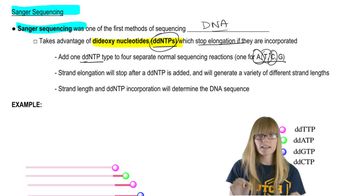
Dideoxynucleotide sequencing, also known as Sanger sequencing, is a method used to determine the nucleotide sequence of DNA. It involves incorporating dideoxynucleotides, which terminate DNA strand elongation, allowing for the generation of fragments of varying lengths. By analyzing these fragments through gel electrophoresis, researchers can deduce the sequence of the original DNA strand.
Video consigliato:
Percorso guidato
04:12
Sanger Sequencing

Codons and Genetic Code

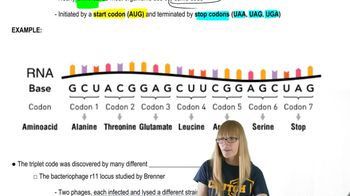
Codons are sequences of three nucleotides in DNA or RNA that correspond to specific amino acids or stop signals during protein synthesis. The genetic code is universal and dictates how sequences of nucleotides are translated into proteins. Understanding the codons present in the sequenced DNA is essential for determining the corresponding amino acid sequence of the protein.
Video consigliato:
Percorso guidato
11:43
The Genetic Code

Strand Polarity

Strand polarity refers to the orientation of the DNA strands, which are antiparallel and have distinct 5' and 3' ends. The 5' end has a phosphate group, while the 3' end has a hydroxyl group. When writing DNA sequences, it is crucial to indicate the polarity to ensure accurate representation of the genetic information, as the directionality affects replication and transcription processes.
Video consigliato:
Percorso guidato
03:03
Double Strand Breaks
Pratica correlata
Domanda del libro di testo

Common baker's yeast (Saccharomyces cerevisiae) is normally grown at 37°C, but it will grow actively at temperatures down to approximately 25°C. A haploid culture of wild-type yeast is mutagenized with EMS. Cells from the mutagenized culture are spread on a complete-medium plate and grown at 25°C. Six colonies (1 to 6) are selected from the original complete-medium plate and transferred to two fresh complete-medium plates. The new complete plates (shown) are grown at 25°C and 37°C. Four replica plates are made onto minimal medium or minimal plus adenine from the 25°C complete-medium plate. The new plates are grown at either 25°C or 37°C and the growth results are shown.

Classify the nature of the mutations in colonies 1, 2, and 5.

460
views
Domanda del libro di testo

The two gels illustrated contain dideoxynucleotide DNA-sequencing information for a wild-type segment and mutant segment of DNA corresponding to the N-terminal end of a protein. The start codon and the next five codons are sequenced.

Identify the template and nontemplate strands of DNA.

605
views
Domanda del libro di testo

Common baker's yeast (Saccharomyces cerevisiae) is normally grown at 37°C, but it will grow actively at temperatures down to approximately 25°C. A haploid culture of wild-type yeast is mutagenized with EMS. Cells from the mutagenized culture are spread on a complete-medium plate and grown at 25°C. Six colonies (1 to 6) are selected from the original complete-medium plate and transferred to two fresh complete-medium plates. The new complete plates (shown) are grown at 25°C and 37°C. Four replica plates are made onto minimal medium or minimal plus adenine from the 25°C complete-medium plate. The new plates are grown at either 25°C or 37°C and the growth results are shown.

Which colonies are prototrophic and which are auxotrophic? What growth information is used to make these determinations?

609
views
Domanda del libro di testo

Common baker's yeast (Saccharomyces cerevisiae) is normally grown at 37°C, but it will grow actively at temperatures down to approximately 25°C. A haploid culture of wild-type yeast is mutagenized with EMS. Cells from the mutagenized culture are spread on a complete-medium plate and grown at 25°C. Six colonies (1 to 6) are selected from the original complete-medium plate and transferred to two fresh complete-medium plates. The new complete plates (shown) are grown at 25°C and 37°C. Four replica plates are made onto minimal medium or minimal plus adenine from the 25°C complete-medium plate. The new plates are grown at either 25°C or 37°C and the growth results are shown.

What can you say about colony 4?

1034
views
Domanda del libro di testo

The two gels illustrated contain dideoxynucleotide DNA-sequencing information for a wild-type segment and mutant segment of DNA corresponding to the N-terminal end of a protein. The start codon and the next five codons are sequenced.

Determine the amino acid sequences translated from these mRNAs.

584
views
Domanda del libro di testo

The two gels illustrated contain dideoxynucleotide DNA-sequencing information for a wild-type segment and mutant segment of DNA corresponding to the N-terminal end of a protein. The start codon and the next five codons are sequenced.

Write out the mRNA sequences encoded by each template strand, and underline the start codons.

587
views