What are the roles of the Polycomb and Trithorax complexes in eukaryotic gene regulation?
Ch. 13 - Regulation of Gene Expression in Eukaryotes

Sanders3rd EditionGenetic Analysis: An Integrated ApproachISBN: 9780135564172Non è quello che usi tu?Cambia libro di testo
Tutti i libri di testo
Sanders 3rd Edition
Ch. 13 - Regulation of Gene Expression in Eukaryotes
Problema 6
Sanders 3rd Edition
Ch. 13 - Regulation of Gene Expression in Eukaryotes
Problema 6Capitolo 13, Problema 6
Outline the roles of RNA in eukaryotic gene regulation.
Guida verificata passo dopo passo1
Understand that RNA plays a central role in eukaryotic gene regulation by influencing transcription, RNA processing, and translation. Begin by identifying the types of RNA involved: mRNA, tRNA, rRNA, and regulatory RNAs such as miRNA, siRNA, and lncRNA.
Explore the role of microRNAs (miRNAs) and small interfering RNAs (siRNAs) in post-transcriptional regulation. These small RNAs bind to complementary sequences on target mRNAs, leading to mRNA degradation or inhibition of translation.
Examine the role of long non-coding RNAs (lncRNAs) in gene regulation. lncRNAs can act as scaffolds, decoys, or guides to recruit chromatin-modifying complexes, thereby influencing transcriptional activity.
Discuss the role of RNA in alternative splicing. Pre-mRNA undergoes splicing to remove introns, and the inclusion or exclusion of specific exons can generate multiple protein isoforms from a single gene, regulated by splicing factors and RNA-binding proteins.
Highlight the role of RNA in epigenetic regulation. For example, certain RNAs can recruit chromatin-modifying enzymes to specific genomic loci, leading to changes in histone modifications or DNA methylation, which affect gene expression.

Risposta video verificata per un problema simile:
Questa soluzione video è stata consigliata dai nostri tutor come utile per risolvere questo problema.
Durata del video:
2mConcetti chiave
Ecco i concetti essenziali che devi comprendere per rispondere correttamente alla domanda.
Types of RNA
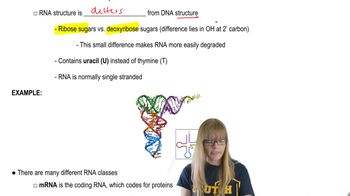
In eukaryotic cells, several types of RNA play crucial roles in gene regulation. Messenger RNA (mRNA) carries genetic information from DNA to ribosomes for protein synthesis. Ribosomal RNA (rRNA) forms the core of ribosome structure and function, while transfer RNA (tRNA) helps in translating mRNA into proteins. Additionally, non-coding RNAs, such as microRNAs (miRNAs) and long non-coding RNAs (lncRNAs), are involved in regulating gene expression at various levels.
Video consigliato:
Transcriptional Regulation
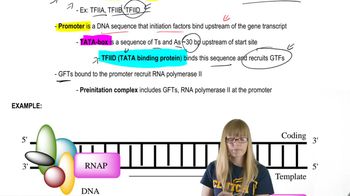
Transcriptional regulation is the process by which the synthesis of mRNA is controlled, influencing gene expression. This involves transcription factors that bind to specific DNA sequences near genes, either promoting or inhibiting transcription. RNA polymerase, the enzyme responsible for synthesizing RNA, is recruited or blocked by these factors, determining whether a gene is expressed. This regulation is essential for cellular differentiation and response to environmental signals.
Video consigliato:
Percorso guidato
Eukaryotic Transcription
Post-Transcriptional Modifications
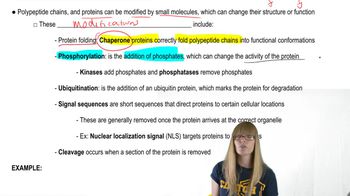
After transcription, RNA undergoes several modifications that affect its stability and translation efficiency. These include 5' capping, polyadenylation, and splicing, which remove introns and join exons. These modifications not only protect mRNA from degradation but also facilitate its export from the nucleus and enhance translation. Additionally, regulatory RNAs like miRNAs can bind to mRNA, leading to its degradation or inhibition of translation, further fine-tuning gene expression.
Video consigliato:
Percorso guidato
Post Translational Modifications
Pratica correlata
Domanda del libro di testo
554
views
Domanda del libro di testo
Compare and contrast the transcriptional regulation of GAL genes in yeast with that of the lac genes in bacteria.
731
views
Domanda del libro di testo
Describe the roles of writers, readers, and erasers in eukaryotic gene regulation.
502
views
Domanda del libro di testo
What is meant by the term chromatin remodeling? Describe the importance of this process to transcription.
441
views
Domanda del libro di testo
The term heterochromatin refers to heavily condensed regions of chromosomes that are largely devoid of genes. Since few genes exist there, these regions almost never decondense for transcription. At what point during the cell cycle would you expect to observe the decondensation of heterochromatic regions? Why?
498
views
Domanda del libro di testo
What general role does acetylation of histone protein amino acids play in the transcription of eukaryotic genes?
563
views