Ch. 13 - Regulation of Gene Expression in Eukaryotes
Sanders - Genetic Analysis: An Integrated Approach 3rd Edition
Sanders3rd EditionGenetic Analysis: An Integrated ApproachISBN: 9780135564172Non è quello che usi tu?Cambia libro di testo
Capitolo 13, Problema 4

What general role does acetylation of histone protein amino acids play in the transcription of eukaryotic genes?

Guida verificata passo dopo passo
1
Understand that histones are proteins around which DNA is wrapped in eukaryotic cells, forming a structure called chromatin. This packaging can regulate gene expression by controlling the accessibility of DNA to transcription machinery.
Recognize that acetylation is a chemical modification where an acetyl group (CH₃CO) is added to the amino acid residues of histone proteins, typically lysine residues in the histone tails.
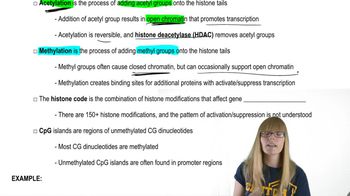
Learn that acetylation of histones neutralizes the positive charge on lysine residues, reducing the interaction between histones and the negatively charged DNA. This loosens the chromatin structure, making it more open.
Understand that the open chromatin structure allows transcription factors and RNA polymerase to access the DNA more easily, thereby promoting the transcription of genes.
Conclude that histone acetylation generally plays a role in activating gene expression by increasing the accessibility of DNA to the transcriptional machinery.

Risposta video verificata per un problema simile:

Questa soluzione video è stata consigliata dai nostri tutor come utile per risolvere questo problema.
Durata del video:
3m

Concetti chiave

Ecco i concetti essenziali che devi comprendere per rispondere correttamente alla domanda.

Histone Acetylation

Histone acetylation is a post-translational modification where acetyl groups are added to the amino acids of histone proteins. This modification reduces the positive charge on histones, leading to a more relaxed chromatin structure. As a result, the DNA becomes more accessible for transcription factors and RNA polymerase, facilitating gene expression.
Video consigliato:
Percorso guidato
07:55
Histone Protein Modifications

Chromatin Structure

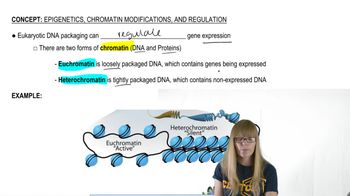
Chromatin is the complex of DNA and proteins that forms chromosomes within the nucleus of eukaryotic cells. It exists in two forms: euchromatin, which is loosely packed and transcriptionally active, and heterochromatin, which is tightly packed and transcriptionally inactive. The acetylation of histones promotes the transition from heterochromatin to euchromatin, thereby enhancing transcription.
Video consigliato:

Transcription Regulation

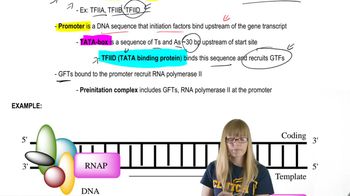
Transcription regulation refers to the mechanisms that control the rate and timing of gene expression. Acetylation of histones is a key regulatory mechanism that influences transcription by altering chromatin structure. This modification works in conjunction with other factors, such as transcription factors and co-activators, to initiate and enhance the transcription of specific genes.
Video consigliato:
Percorso guidato
09:16
Eukaryotic Transcription