Domanda del libro di testo
Compare and contrast promoters and enhancers with respect to their location (upstream versus downstream), orientation, and distance (in base pairs) relative to a gene they regulate.
741
views

 Sanders 3rd EditionCh. 13 - Regulation of Gene Expression in EukaryotesProblema 14
 Guida verificata passo dopo passo
 09:22
09:22
 04:35
04:35Compare and contrast promoters and enhancers with respect to their location (upstream versus downstream), orientation, and distance (in base pairs) relative to a gene they regulate.
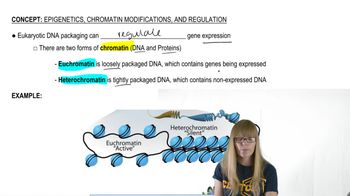
What are the different chromatin classifications, and what is their relationship to gene expression?
Define epigenetics, and provide examples illustrating your definition.
How does dsRNA lead to posttranscriptonal gene silencing?
A hereditary disease is inherited as an autosomal recessive trait1. The wild-type allele of the disease gene produces a mature mRNA that is 1250 nucleotides (nt) long. Molecular analysis shows that the mature mRNA consists of four exons that measure 400 nt (exon 1), 320 nt (exon 2), 230 nt (exon 3), and 300 nt (exon 4). A mother and father with two healthy children and two children with the disease have northern blot analysis performed in a medical genetics laboratory. The results of the northern blot for each family member are shown here. Identify the genotype of each family member, using the sizes of mRNAs to indicate each allele. (For example, a person who is homozygous wild type is indicated as '1250/1250.')
What are the sources of dsRNA? Diagram the mechanisms by which dsRNAs are produced and processed into small RNAs.