Ch. 14 - Analysis of Gene Function via Forward Genetics and Reverse Genetics
Sanders - Genetic Analysis: An Integrated Approach 3rd Edition
Sanders3rd EditionGenetic Analysis: An Integrated ApproachISBN: 9780135564172Non è quello che usi tu?Cambia libro di testo
Capitolo 14, Problema C.9a

Go to the website http://www.cancer.gov and select 'Cancer Types' on the top menu bar. Scroll down to 'Breast Cancer' and click. Select 'Cases & Prevention' from the options. Click 'More information' and select 'BRCA Mutations: Cancer Risk and Genetic Testing'. Use the information on this page to answer the following questions. What are the approximate percentage increases in risk of having breast cancer and of having ovarian cancer for women inheriting harmful mutations of BRCA1 and BRCA2 compared with the risks in the general population?

Guida verificata passo dopo passo
1
Understand that BRCA1 and BRCA2 are genes where harmful mutations significantly increase the risk of breast and ovarian cancers compared to the general population.
Navigate to the specified website and locate the section on 'BRCA Mutations: Cancer Risk and Genetic Testing' to find reliable, up-to-date statistics on cancer risk associated with these mutations.
Identify the baseline risk percentages for breast and ovarian cancer in the general population, which serve as the reference point for comparison.
Find the reported lifetime risk percentages for breast and ovarian cancer in women who inherit harmful BRCA1 and BRCA2 mutations.
Calculate the approximate percentage increase in risk by comparing the mutation carriers' risk to the general population risk, using the formula: Percentage Increase = Risk in Mutation Carriers - Risk in General Population × 100.

Risposta video verificata per un problema simile:

Questa soluzione video è stata consigliata dai nostri tutor come utile per risolvere questo problema.
Durata del video:
2m

Concetti chiave

Ecco i concetti essenziali che devi comprendere per rispondere correttamente alla domanda.

BRCA1 and BRCA2 Genes

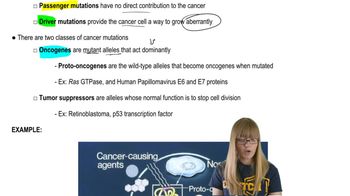
BRCA1 and BRCA2 are human genes that produce proteins responsible for repairing damaged DNA. Mutations in these genes can impair DNA repair, leading to increased risks of certain cancers, especially breast and ovarian cancer. Understanding these genes helps explain why some individuals have a higher inherited cancer risk.
Video consigliato:

Genetic Mutation and Cancer Risk

A genetic mutation is a change in the DNA sequence that can affect gene function. Harmful mutations in BRCA1 or BRCA2 significantly increase the likelihood of developing breast and ovarian cancers compared to the general population. This concept is key to interpreting how inherited mutations influence cancer risk percentages.
Video consigliato:
Percorso guidato
04:46
Cancer Mutations

Relative Risk and Population Risk Comparison

Relative risk compares the probability of an event, like cancer, occurring in a group with a specific factor (e.g., BRCA mutation) to the probability in the general population. Understanding this helps quantify how much more likely mutation carriers are to develop cancer compared to those without the mutation.
Video consigliato:
Percorso guidato
06:59
RNA Interference
Pratica correlata
Domanda del libro di testo

Go to the website http://www.cancer.gov and select 'Cancer Types' on the top menu bar. Scroll down to 'Breast Cancer' and click. Select 'Cases & Prevention' from the options. Click 'More information' and select 'BRCA Mutations: Cancer Risk and Genetic Testing'. Use the information on this page to answer the following questions. With regard to the results of genetic testing for BRCA1 and BRCA2 mutations, what is meant by a 'positive result'?

410
views
Domanda del libro di testo

Go to the website http://www.cancer.gov and select 'Cancer Types' on the top menu bar. Scroll down to 'Breast Cancer' and click. Select 'Cases & Prevention' from the options. Click 'More information' and select 'BRCA Mutations: Cancer Risk and Genetic Testing'. Use the information on this page to answer the following questions. Are there measures a woman with a positive result can take to lessen her chances of developing cancer or to catch a cancer early in its development?

515
views
Domanda del libro di testo

What kind of information will be made available by The Cancer Genome Atlas (TCGA)? What sort of role do you think TCGA information will play in cancer diagnosis and cancer treatment in the future?

620
views
Domanda del libro di testo

Discuss the advantages (and possible disadvantages) of the different mutagens in the following table:

483
views
Domanda del libro di testo

Go to the website http://www.cancer.gov and select 'Cancer Types' on the top menu bar. Scroll down to 'Breast Cancer' and click. Select 'Cases & Prevention' from the options. Click 'More information' and select 'BRCA Mutations: Cancer Risk and Genetic Testing'. Use the information on this page to answer the following questions. As a special project, instead of selecting 'Breast Cancer' from the list of types of cancer, select another cancer you would like to know more about and produce a short summary of what you find.

488
views
Domanda del libro di testo

Go to the website http://www.cancer.gov and select 'Cancer Types' on the top menu bar. Scroll down to 'Breast Cancer' and click. Select 'Cases & Prevention' from the options. Click 'More information' and select 'BRCA Mutations: Cancer Risk and Genetic Testing'. Use the information on this page to answer the following questions. What features of family history increase the likelihood that a woman will have a harmful mutation of BRCA1 or BRCA2?

428
views