Ch. 16 - Genomics: Genetics from a Whole-Genome Perspective
Sanders - Genetic Analysis: An Integrated Approach 3rd Edition
Sanders3rd EditionGenetic Analysis: An Integrated ApproachISBN: 9780135564172Non è quello che usi tu?Cambia libro di testo
Capitolo 16, Problema 10

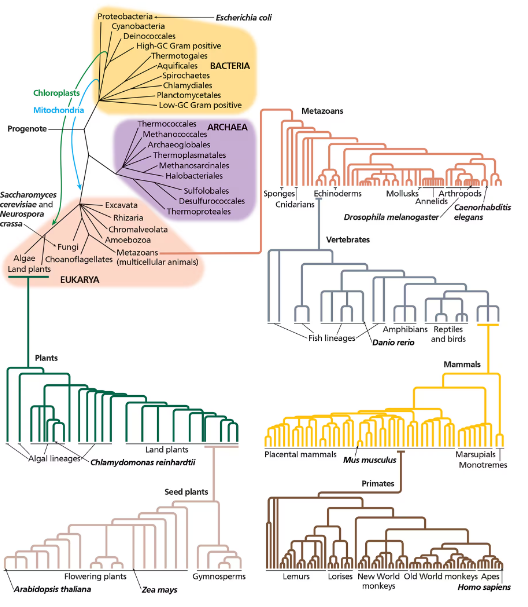
Based on the tree of life in the following figure (Figure 16.12), would you expect human proteins to be more similar to fungal proteins or to plant proteins? Would you expect plant proteins to be more similar to fungal proteins or to human proteins?
Tree of life diagram illustrating evolutionary relationships among organisms, highlighting humans, plants, and fungi.

Guida verificata passo dopo passo
1
Examine the tree of life in Figure 16.12, which illustrates evolutionary relationships among organisms. Identify the placement of humans, fungi, and plants on the tree.
Understand that organisms closer to each other on the tree of life share a more recent common ancestor, which implies greater genetic and protein similarity.
Note that humans and fungi are both part of the Opisthokonta clade, indicating a closer evolutionary relationship compared to plants, which belong to a separate clade (Archaeplastida). This suggests human proteins are more similar to fungal proteins than to plant proteins.
Compare the evolutionary relationship between plants and fungi. Since fungi and plants are in separate clades, their proteins are less similar compared to the relationship between plants and humans, which are even more distantly related.
Conclude that protein similarity is determined by evolutionary proximity, and organisms within the same clade or closer branches of the tree of life will have more similar proteins due to shared ancestry.

Risposta video verificata per un problema simile:

Questa soluzione video è stata consigliata dai nostri tutor come utile per risolvere questo problema.
Durata del video:
2m

Concetti chiave

Ecco i concetti essenziali che devi comprendere per rispondere correttamente alla domanda.

Phylogenetic Tree

A phylogenetic tree is a diagram that represents evolutionary relationships among various biological species based on similarities and differences in their genetic characteristics. It illustrates how species are related through common ancestry, allowing for predictions about the genetic similarities between organisms. Understanding the tree of life helps in determining which organisms share more recent common ancestors, thus influencing protein similarity.
Video consigliato:
Percorso guidato
08:16
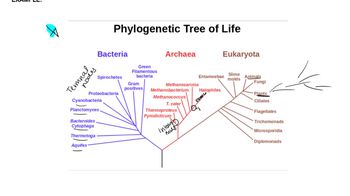
Phylogenetic Trees

Protein Homology

Protein homology refers to the similarity in protein sequences that arises from shared ancestry. Proteins that are homologous are likely to have similar structures and functions due to their evolutionary origins. By analyzing protein homology, one can infer evolutionary relationships and predict functional similarities between proteins from different organisms, such as humans, fungi, and plants.
Video consigliato:

Common Ancestry

Common ancestry is the concept that different species share a common ancestor from which they have evolved over time. This principle is fundamental in evolutionary biology and helps explain the genetic and phenotypic similarities observed among species. In the context of the question, understanding common ancestry allows for predictions about the degree of similarity between human, fungal, and plant proteins based on their evolutionary paths.
Video consigliato:
Percorso guidato
08:16
Phylogenetic Trees
Pratica correlata
Domanda del libro di testo

When comparing genes from two sequenced genomes, how does one determine whether two genes are orthologous? What pitfalls arise when one or both of the genomes are not sequenced?

525
views
Domanda del libro di testo

You have just obtained 100 kb of genomic sequence from an as-yet-unsequenced mammalian genome. What are three methods you might use to identify potential genes in the 100 kb? What are the advantages and limitations of each method?

617
views
Domanda del libro di testo

Diseases and conditions on the RUSP list are tested on every newborn infant, and if the baby has one of the conditions, the parents are immediately informed. What kind of information and counseling should be provided to the parents along with the diagnosis?

555
views
Domanda del libro di testo

The two-hybrid method facilitates the discovery of protein–protein interactions. How does this technique work? Can you think of reasons for obtaining a false-positive result, that is, where the proteins encoded by two clones interact in the two-hybrid system but do not interact in the organism in which they naturally occur? Can you think of reasons you might obtain a false-negative result, in which the two proteins interact in vivo but fail to interact in the two-hybrid system?

405
views
Domanda del libro di testo

The human genome contains a large number of pseudogenes. How would you distinguish whether a particular sequence encodes a gene or a pseudogene? How do pseudogenes arise?

621
views
Domanda del libro di testo

What is a reference genome? How can it be used to survey genetic variation within a species?

613
views