Ch. 16 - Genomics: Genetics from a Whole-Genome Perspective
Sanders - Genetic Analysis: An Integrated Approach 3rd Edition
Sanders3rd EditionGenetic Analysis: An Integrated ApproachISBN: 9780135564172Non è quello che usi tu?Cambia libro di testo
Capitolo 16, Problema 9

The human genome contains a large number of pseudogenes. How would you distinguish whether a particular sequence encodes a gene or a pseudogene? How do pseudogenes arise?

Guida verificata passo dopo passo
1
Understand the definition of pseudogenes: Pseudogenes are non-functional sequences in the genome that resemble functional genes but have lost their ability to encode proteins due to mutations or other changes.
To distinguish between a gene and a pseudogene, analyze the sequence for key features of functional genes, such as the presence of an intact open reading frame (ORF), regulatory elements (e.g., promoters), and splice sites. Pseudogenes often lack these features or have mutations disrupting them.
Perform comparative genomic analysis: Compare the sequence in question to known functional genes. Pseudogenes often show high sequence similarity to functional genes but may contain stop codons, frameshift mutations, or deletions that prevent proper protein synthesis.
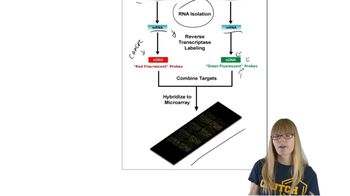
Investigate transcriptional activity: Use techniques like RT-PCR or RNA sequencing to determine if the sequence is transcribed into RNA. Functional genes are typically transcribed, while pseudogenes may not be actively transcribed or produce non-functional RNA.
Understand how pseudogenes arise: Pseudogenes can originate through processes such as gene duplication followed by mutation (resulting in non-functional copies) or retrotransposition, where reverse-transcribed RNA is inserted back into the genome without proper regulatory elements.

Risposta video verificata per un problema simile:

Questa soluzione video è stata consigliata dai nostri tutor come utile per risolvere questo problema.
Durata del video:
1m

Concetti chiave

Ecco i concetti essenziali che devi comprendere per rispondere correttamente alla domanda.

Gene vs. Pseudogene

A gene is a sequence of DNA that encodes a functional product, typically a protein, while a pseudogene is a non-functional sequence that resembles a gene but has lost its ability to be expressed. Pseudogenes can arise from mutations that disrupt the coding sequence or regulatory elements necessary for gene expression, rendering them inactive.
Video consigliato:

Functional Analysis

To distinguish between a gene and a pseudogene, functional analysis is crucial. This involves examining the sequence for features such as open reading frames (ORFs), promoter regions, and conservation across species. If a sequence lacks these features or shows signs of degradation, it is likely a pseudogene.
Video consigliato:
Percorso guidato
08:26
Functional Genomics

Mechanisms of Pseudogene Formation

Pseudogenes can arise through several mechanisms, including gene duplication, retrotransposition, and point mutations. Gene duplication creates a copy of a gene that may accumulate mutations over time, while retrotransposition involves the reverse transcription of mRNA into DNA, which can insert non-functional copies into the genome.
Video consigliato:
Percorso guidato
04:06
Formation of Plant Gametes
Pratica correlata
Domanda del libro di testo

Based on the tree of life in the following figure (Figure 16.12), would you expect human proteins to be more similar to fungal proteins or to plant proteins? Would you expect plant proteins to be more similar to fungal proteins or to human proteins?

487
views
Domanda del libro di testo

When comparing genes from two sequenced genomes, how does one determine whether two genes are orthologous? What pitfalls arise when one or both of the genomes are not sequenced?

525
views
Domanda del libro di testo

You have just obtained 100 kb of genomic sequence from an as-yet-unsequenced mammalian genome. What are three methods you might use to identify potential genes in the 100 kb? What are the advantages and limitations of each method?

617
views
Domanda del libro di testo

Diseases and conditions on the RUSP list are tested on every newborn infant, and if the baby has one of the conditions, the parents are immediately informed. What kind of information and counseling should be provided to the parents along with the diagnosis?

555
views
Domanda del libro di testo

You have sequenced a 100-kb region of the Bacillus anthracis genome (the bacterium that causes anthrax) and a 100-kb region from the Gorilla gorilla genome. What differences and similarities might you expect to see in the annotation of the sequences, for example, in the number of genes, gene structure, regulatory sequences, and repetitive DNA?

375
views
Domanda del libro di testo

What is a reference genome? How can it be used to survey genetic variation within a species?

613
views