Ch. 18 - Developmental Genetics
Sanders - Genetic Analysis: An Integrated Approach 3rd Edition
Sanders3rd EditionGenetic Analysis: An Integrated ApproachISBN: 9780135564172Non è quello che usi tu?Cambia libro di testo
Capitolo 18, Problema 13a

The bicoid gene is a coordinate maternal-effect gene.
A female Drosophila heterozygous for a loss-of-function bicoid allele is mated to a male that is heterozygous for the same allele. What are the phenotypes of their progeny?

Guida verificata passo dopo passo
1
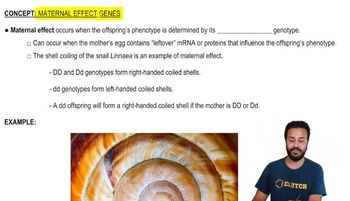
Understand the concept of a maternal-effect gene: Maternal-effect genes, like bicoid, are genes whose products (mRNA or proteins) are deposited into the egg by the mother. The phenotype of the offspring is determined by the genotype of the mother, not the offspring's own genotype.
Determine the genotypes of the parents: The female is heterozygous for the bicoid gene (Bicoid+/Bicoid−), and the male is also heterozygous (Bicoid+/Bicoid−).
Predict the offspring genotypes: Perform a Punnett square for the cross Bicoid+/Bicoid− × Bicoid+/Bicoid−. The possible offspring genotypes are Bicoid+/Bicoid+, Bicoid+/Bicoid−, and Bicoid−/Bicoid− in a 1:2:1 ratio.
Determine the phenotypes based on the maternal genotype: Since bicoid is a maternal-effect gene, the phenotype of the offspring depends on the mother's genotype. A heterozygous mother (Bicoid+/Bicoid−) will produce functional bicoid mRNA, so all her offspring will develop normally, regardless of their own genotype.
Conclude the phenotypes: The progeny of this cross will all have normal phenotypes because the mother is heterozygous and can provide sufficient bicoid gene product for proper development.

Risposta video verificata per un problema simile:

Questa soluzione video è stata consigliata dai nostri tutor come utile per risolvere questo problema.
Durata del video:
3m

Concetti chiave

Ecco i concetti essenziali che devi comprendere per rispondere correttamente alla domanda.

Bicoid Gene Function

The bicoid gene is crucial for early embryonic development in Drosophila, acting as a maternal-effect gene that establishes the anterior-posterior axis. It encodes a transcription factor that regulates the expression of other genes necessary for proper head and thorax formation. Mutations in this gene can lead to severe developmental defects, particularly affecting the anterior structures of the embryo.
Video consigliato:
Percorso guidato
08:26
Functional Genomics

Maternal Effect Genes

Maternal effect genes are genes expressed in the mother that produce products (like mRNA or proteins) which are deposited into the egg. These products influence the development of the embryo before the zygotic genome is activated. In the case of bicoid, the maternal contribution is essential for the initial stages of development, meaning that the phenotype of the offspring can be affected by the mother's genotype.
Video consigliato:
Percorso guidato
03:38
Maternal Effect

Genotype and Phenotype Relationship

The genotype refers to the genetic constitution of an organism, while the phenotype is the observable physical or biochemical characteristics. In this scenario, the progeny of a cross between two heterozygous bicoid parents will exhibit a range of phenotypes based on the combination of alleles inherited. Understanding this relationship is key to predicting the phenotypic outcomes in the offspring, especially in the context of loss-of-function alleles.
Video consigliato:
Percorso guidato
07:52
Gamete Genotypes
Pratica correlata
Domanda del libro di testo

The bicoid gene is a coordinate maternal–effect gene. A female that is homozygous for a loss-of-function bicoid allele is mated to a wild-type male. What are the phenotypes of their progeny?

1071
views
Domanda del libro di testo

In mammals, identical twins arise when an embryo derived from a single fertilized egg splits into two independent embryos, producing two genetically identical individuals.

The converse phenotype, fusion of two genetically distinct embryos into a single individual, is also known. What are the genetic implications of such an event?

418
views
Domanda del libro di testo

In gain-of-function let-23 and let-60 C. elegans mutants, all of the vulval precursor cells differentiate with 1° or 2° fates. Do you expect adjacent cells to differentiate with 1° fates or with 2° fates? Explain.

445
views
Domanda del libro di testo

The bicoid gene is a coordinate maternal–effect gene. If loss of bicoid function in the egg leads to lethality during embryogenesis, how are females homozygous for bicoid produced? What is the phenotype of a male homozygous for bicoid loss-of-function alleles?

400
views
Domanda del libro di testo

Given that maternal Bicoid activates the expression of hunchback, what would be the consequence of adding extra copies of the bicoid gene by transgenic means to a wild-type female with two copies, thus creating a female fly with three or four copies of the bicoid gene? How would the hunchback expression be altered? What about the expression of other gap genes and pair-rule genes?

661
views
Domanda del libro di testo

In mammals, identical twins arise when an embryo derived from a single fertilized egg splits into two independent embryos, producing two genetically identical individuals.

What limits might there be, from a developmental genetic viewpoint, as to when this can occur?

410
views