Ch. 2 - Transmission Genetics
Sanders - Genetic Analysis: An Integrated Approach 3rd Edition
Sanders3rd EditionGenetic Analysis: An Integrated ApproachISBN: 9780135564172Non è quello che usi tu?Cambia libro di testo
Capitolo 2, Problema 1a

Compare and contrast the following terms:
Dominant and Recessive

Guida verificata passo dopo passo
1
Understand the definitions: A dominant allele is one that expresses its trait in the phenotype even when only one copy is present (heterozygous condition). A recessive allele, on the other hand, only expresses its trait in the phenotype when two copies are present (homozygous condition).
Consider the genetic notation: Dominant alleles are typically represented by uppercase letters (e.g., 'A'), while recessive alleles are represented by lowercase letters (e.g., 'a').
Examine inheritance patterns: In a heterozygous individual (e.g., genotype 'Aa'), the dominant allele will mask the expression of the recessive allele, resulting in the dominant phenotype.
Relate to real-world examples: For instance, in pea plants, the allele for tall height (T) is dominant, while the allele for short height (t) is recessive. A plant with the genotype 'Tt' will be tall because the dominant allele (T) is expressed.
Summarize the key difference: Dominant alleles require only one copy to influence the phenotype, while recessive alleles require two copies to be expressed in the phenotype.

Risposta video verificata per un problema simile:

Questa soluzione video è stata consigliata dai nostri tutor come utile per risolvere questo problema.
Durata del video:
1m

Concetti chiave

Ecco i concetti essenziali che devi comprendere per rispondere correttamente alla domanda.

Dominant Alleles

Dominant alleles are variants of a gene that express their traits even when only one copy is present in the genotype. This means that if an individual has at least one dominant allele for a trait, that trait will be observed in the phenotype. For example, in pea plants, the allele for tall stems (T) is dominant over the allele for short stems (t), so a plant with either TT or Tt will be tall.
Video consigliato:
Percorso guidato
04:37
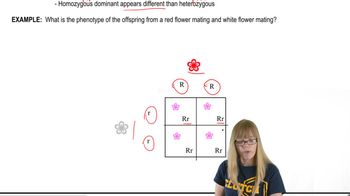
Variations on Dominance

Recessive Alleles

Recessive alleles are gene variants that only express their traits when two copies are present in the genotype. If an individual has only one recessive allele, the dominant allele will mask its effect, and the recessive trait will not be observed in the phenotype. Using the same pea plant example, a plant must have the genotype tt to exhibit the short stem trait, as the presence of a dominant T allele would prevent this.
Video consigliato:
Percorso guidato
03:03
New Alleles and Migration

Mendelian Inheritance

Mendelian inheritance refers to the patterns of inheritance first described by Gregor Mendel, which include the principles of dominance and recessiveness. According to these principles, traits are determined by alleles that segregate during gamete formation, leading to predictable ratios of dominant and recessive traits in offspring. This foundational concept in genetics helps explain how traits are passed from parents to offspring and is crucial for understanding genetic variation.
Video consigliato:
Percorso guidato
05:13
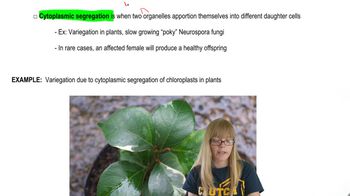
Organelle Inheritance