Ch. 2 - Transmission Genetics
Sanders - Genetic Analysis: An Integrated Approach 3rd Edition
Sanders3rd EditionGenetic Analysis: An Integrated ApproachISBN: 9780135564172Non è quello che usi tu?Cambia libro di testo
Capitolo 2, Problema 1c

Compare and contrast the following terms:
Homozygous and Heterozygous

Guida verificata passo dopo passo
1
Define the term 'homozygous': An organism is homozygous for a gene when it has two identical alleles for that gene. For example, if the gene for flower color has alleles 'A' (dominant) and 'a' (recessive), a homozygous individual could have the genotype AA or aa.
Define the term 'heterozygous': An organism is heterozygous for a gene when it has two different alleles for that gene. Using the same example, a heterozygous individual would have the genotype Aa.
Explain the functional difference: In a homozygous individual, the trait expressed is determined solely by the identical alleles present. In a heterozygous individual, the dominant allele typically masks the effect of the recessive allele, leading to the expression of the dominant trait.
Discuss inheritance patterns: Homozygous individuals can only pass on one type of allele to their offspring (e.g., A or a), while heterozygous individuals can pass on either allele (A or a) with equal probability.
Summarize the comparison: Homozygous refers to having identical alleles for a gene, while heterozygous refers to having different alleles. This distinction is important in understanding inheritance patterns, phenotypic expression, and genetic diversity.

Risposta video verificata per un problema simile:

Questa soluzione video è stata consigliata dai nostri tutor come utile per risolvere questo problema.
Durata del video:
1m

Concetti chiave

Ecco i concetti essenziali che devi comprendere per rispondere correttamente alla domanda.

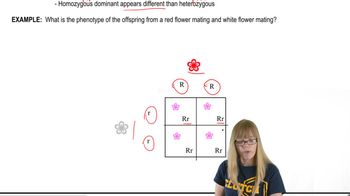
Homozygous

Homozygous refers to a genetic condition where an individual has two identical alleles for a specific gene. This means that both inherited copies of the gene, one from each parent, are the same, which can be either dominant or recessive. For example, an individual with two alleles for blue eyes (bb) is homozygous for that trait.
Video consigliato:
Percorso guidato
04:37
Variations on Dominance

Heterozygous

Heterozygous describes a genetic scenario where an individual possesses two different alleles for a particular gene. This means that one allele is inherited from one parent and a different allele from the other. For instance, an individual with one allele for brown eyes (B) and one for blue eyes (b) is heterozygous for eye color.
Video consigliato:
Percorso guidato
04:37
Variations on Dominance

Genetic Variation

Genetic variation refers to the diversity in gene frequencies within a population. It is crucial for evolution and adaptation, as it provides the raw material for natural selection. The presence of homozygous and heterozygous individuals contributes to this variation, influencing traits and the overall genetic makeup of a population.
Video consigliato:
Percorso guidato
09:28
Genomic Variation