Ch. 2 - Transmission Genetics
Sanders - Genetic Analysis: An Integrated Approach 3rd Edition
Sanders3rd EditionGenetic Analysis: An Integrated ApproachISBN: 9780135564172Non è quello che usi tu?Cambia libro di testo
Capitolo 2, Problema 8a

Determine whether the statements below are true or false. If a statement is false, provide the correct information or revise the statement to make it correct.
If a dihybrid cross is performed, the expected genotypic ratio is 9:3:3:1.

Guida verificata passo dopo passo
1
Understand the context of the problem: A dihybrid cross involves two traits, each controlled by a pair of alleles, and follows Mendel's laws of inheritance. The expected phenotypic ratio for a dihybrid cross is 9:3:3:1, not the genotypic ratio.
Recall the difference between phenotypic and genotypic ratios: The phenotypic ratio refers to the observable traits, while the genotypic ratio refers to the genetic makeup (allele combinations) of the offspring.
Analyze the statement: The statement claims that the expected genotypic ratio for a dihybrid cross is 9:3:3:1. This is incorrect because 9:3:3:1 is the phenotypic ratio, not the genotypic ratio.
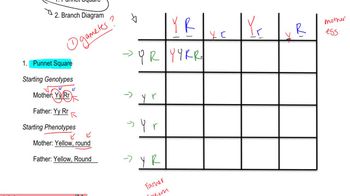
Determine the correct genotypic ratio: For a dihybrid cross (e.g., AaBb x AaBb), the genotypic ratio is more complex and includes combinations such as AABB, AaBB, AABb, AaBb, etc. You would need to calculate the frequencies of each genotype using a Punnett square.
Revise the statement: The correct version of the statement is: 'If a dihybrid cross is performed, the expected phenotypic ratio is 9:3:3:1, while the genotypic ratio includes multiple combinations and is not represented by 9:3:3:1.'

Risposta video verificata per un problema simile:

Questa soluzione video è stata consigliata dai nostri tutor come utile per risolvere questo problema.
Durata del video:
5m

Concetti chiave

Ecco i concetti essenziali che devi comprendere per rispondere correttamente alla domanda.

Dihybrid Cross

A dihybrid cross is a genetic cross that examines the inheritance of two different traits, each controlled by different genes. In this type of cross, individuals that are heterozygous for both traits are typically used, allowing for the analysis of how these traits segregate independently according to Mendel's law of independent assortment.
Video consigliato:

Genotypic Ratio

The genotypic ratio refers to the relative frequency of different genotypes produced in the offspring from a genetic cross. In a dihybrid cross, the expected genotypic ratio is 1:2:1 for each trait, leading to a combined phenotypic ratio of 9:3:3:1 when considering both traits together, which reflects the variety of combinations of alleles.
Video consigliato:
Percorso guidato
07:52
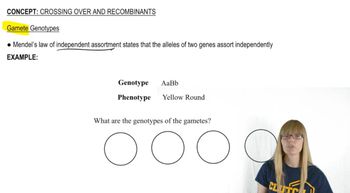
Gamete Genotypes

Mendel's Laws of Inheritance

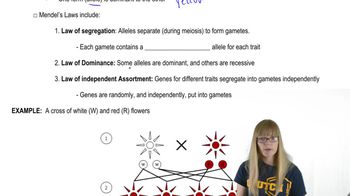
Mendel's laws of inheritance, particularly the law of segregation and the law of independent assortment, describe how alleles segregate during gamete formation. The law of segregation states that allele pairs separate during gamete formation, while the law of independent assortment states that the segregation of one pair of alleles is independent of the segregation of another pair, which is crucial for understanding the outcomes of dihybrid crosses.
Video consigliato: