Ch. 2 - Transmission Genetics
Sanders - Genetic Analysis: An Integrated Approach 3rd Edition
Sanders3rd EditionGenetic Analysis: An Integrated ApproachISBN: 9780135564172Non è quello che usi tu?Cambia libro di testo
Capitolo 2, Problema 7b

If a chi-square test produces a chi-square value of 7.83 with 4 degrees of freedom,
Is the result sufficient to reject the chance hypothesis?

Guida verificata passo dopo passo
1
Determine the null hypothesis: The null hypothesis (H₀) assumes that the observed data fits the expected distribution, meaning any differences are due to random chance.
Identify the degrees of freedom (df): The problem states that there are 4 degrees of freedom. Degrees of freedom are typically calculated as the number of categories minus 1.
Locate the critical value: Use a chi-square distribution table to find the critical value for 4 degrees of freedom at a chosen significance level (commonly α = 0.05).
Compare the chi-square value to the critical value: If the chi-square value (7.83) is greater than the critical value from the table, the null hypothesis is rejected. Otherwise, it is not rejected.
Conclude the result: Based on the comparison, determine whether the result is sufficient to reject the chance hypothesis. If the null hypothesis is rejected, it suggests that the observed data significantly deviates from the expected distribution.

Risposta video verificata per un problema simile:

Questa soluzione video è stata consigliata dai nostri tutor come utile per risolvere questo problema.
Durata del video:
2m

Concetti chiave

Ecco i concetti essenziali che devi comprendere per rispondere correttamente alla domanda.

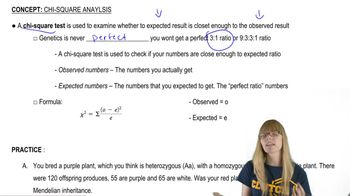
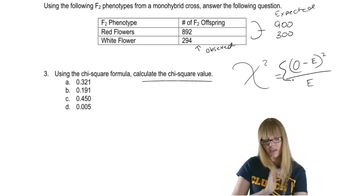
Chi-Square Test

The chi-square test is a statistical method used to determine if there is a significant association between categorical variables. It compares the observed frequencies in each category to the expected frequencies under the null hypothesis, which posits no association. A higher chi-square value indicates a greater discrepancy between observed and expected values.
Video consigliato:
Percorso guidato
02:48
Chi Square Analysis

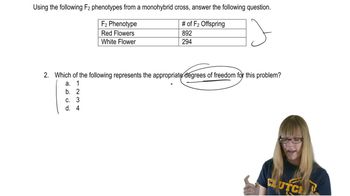
Degrees of Freedom

Degrees of freedom (df) in a chi-square test refer to the number of independent values that can vary in the analysis. It is calculated as the number of categories minus one for goodness-of-fit tests or as the product of (rows - 1) and (columns - 1) for contingency tables. In this case, with 4 degrees of freedom, it indicates the complexity of the data being analyzed.
Video consigliato:

Critical Value

The critical value in a chi-square test is the threshold that the chi-square statistic must exceed to reject the null hypothesis. This value is determined based on the chosen significance level (commonly 0.05) and the degrees of freedom. For 4 degrees of freedom, the critical value is approximately 9.488, meaning a chi-square value of 7.83 does not provide sufficient evidence to reject the chance hypothesis.
Video consigliato: