Ch. 2 - Transmission Genetics
Sanders - Genetic Analysis: An Integrated Approach 3rd Edition
Sanders3rd EditionGenetic Analysis: An Integrated ApproachISBN: 9780135564172Non è quello che usi tu?Cambia libro di testo
Capitolo 2, Problema 47b

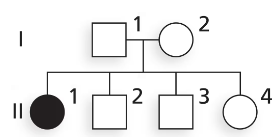
The accompanying pedigree shows a family in which one child (II-1) has an autosomal recessive condition. On the basis of this fact alone, provide the following information.
Pedigree chart showing a family with one child affected by an autosomal recessive condition.
Using the same alleles, give the possible genotypes for II-2, II-3, and II-4.

Guida verificata passo dopo passo
1
Step 1: Understand the inheritance pattern. Autosomal recessive conditions require two copies of the recessive allele (aa) for the phenotype to be expressed. Individuals with one dominant and one recessive allele (Aa) are carriers but do not express the condition.
Step 2: Analyze the pedigree. Individual II-1 has the autosomal recessive condition, meaning their genotype must be homozygous recessive (aa). This implies that both parents (I-1 and I-2) must be carriers (Aa) since they passed on the recessive allele to II-1.
Step 3: Determine the possible genotypes for II-2. Since II-2 is a sibling of II-1, they could inherit either two dominant alleles (AA), one dominant and one recessive allele (Aa), or two recessive alleles (aa). However, the phenotype of II-2 (whether they express the condition or not) will help narrow down the possibilities.
Step 4: Determine the possible genotypes for II-3. If II-3 is unaffected, they could be either homozygous dominant (AA) or heterozygous (Aa). If II-3 is affected, their genotype must be homozygous recessive (aa).
Step 5: Determine the possible genotypes for II-4. Similar to II-2 and II-3, II-4's genotype depends on whether they express the condition. If unaffected, they could be AA or Aa. If affected, they must be aa.

Risposta video verificata per un problema simile:

Questa soluzione video è stata consigliata dai nostri tutor come utile per risolvere questo problema.
Durata del video:
56s

Concetti chiave

Ecco i concetti essenziali che devi comprendere per rispondere correttamente alla domanda.

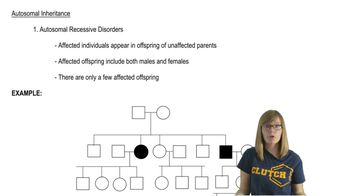
Autosomal Recessive Inheritance

Autosomal recessive inheritance occurs when a trait or condition is expressed only when an individual has two copies of the recessive allele, one inherited from each parent. In this case, if a child has an autosomal recessive condition, both parents must either be carriers (heterozygous) or affected (homozygous recessive). This pattern is crucial for predicting the genotypes of other family members in the pedigree.
Video consigliato:
Percorso guidato
09:08
Autosomal Pedigrees

Genotype and Phenotype

The genotype refers to the genetic makeup of an individual, specifically the alleles present at a given locus, while the phenotype is the observable expression of that genotype. In the context of the pedigree, understanding the relationship between genotype and phenotype helps in determining the possible genotypes of siblings based on the known condition of one child.
Video consigliato:
Percorso guidato
07:52
Gamete Genotypes

Punnett Square

A Punnett square is a diagram used to predict the genetic outcomes of a cross between two individuals. By inputting the possible alleles of the parents, it allows for the visualization of potential genotypes for offspring. This tool is particularly useful in determining the likelihood of each child inheriting the autosomal recessive condition or being a carrier.
Video consigliato:
Percorso guidato
18:27
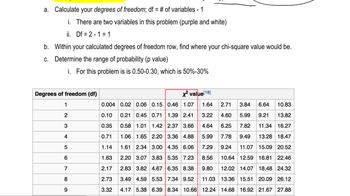
Chi Square Analysis
Pratica correlata
Domanda del libro di testo

The accompanying pedigree shows a family in which one child (II-1) has an autosomal recessive condition. On the basis of this fact alone, provide the following information.

What is the chance that among the three children in generation II who have the dominant phenotype, one of them is AA and two of them are Aa? (Hint: Consider all possible orders of genotypes.)

979
views
Domanda del libro di testo

Alleles of the IGF-1 gene in dogs, encoding insulin-like growth factor, largely determine whether a domestic dog will be large or small. Dogs with an ancestral dominant allele are large, whereas dogs homozygous for the mutant recessive allele are small. Chondrodysplasia, a short-legged phenotype (as in dachshunds and basset hounds), is caused by a dominant gain-of-function allele of the FGF4 gene. The MSTN gene encodes myostatin, a regulator of muscle development. Dogs with a dominant ancestral allele of the MTSN gene have normal muscle development, while dogs homozygous for recessive mutants in the MTSN gene are 'double muscled' and have trouble running quickly. However, dogs heterozygous for the mutant allele run faster than either of the homozygotes.

You breed a pure-breeding small basset hound of normal musculature with a pure-breeding 'bully' whippet, a double-muscled large dog with normal legs.

If the F₁ of this cross is interbred, what proportion of the F₂ are expected to be fast runners and what proportion normal-speed runners?

441
views
Domanda del libro di testo

The accompanying pedigree shows a family in which one child (II-1) has an autosomal recessive condition. On the basis of this fact alone, provide the following information.

What are the probabilities for each of the possible genotypes for II-2, II-3, and II-4?

515
views
Domanda del libro di testo

The accompanying pedigree shows a family in which one child (II-1) has an autosomal recessive condition. On the basis of this fact alone, provide the following information.

Using A for the dominant allele and a for the recessive allele, give the genotypes for I-1, I-2, and II-1.

1318
views
Domanda del libro di testo

The accompanying pedigree shows a family in which one child (II-1) has an autosomal recessive condition. On the basis of this fact alone, provide the following information.

What is the probability that all three of the children in generation II who have the dominant phenotype are Aa?

917
views
Domanda del libro di testo

Alleles of the IGF-1 gene in dogs, encoding insulin-like growth factor, largely determine whether a domestic dog will be large or small. Dogs with an ancestral dominant allele are large, whereas dogs homozygous for the mutant recessive allele are small. Chondrodysplasia, a short-legged phenotype (as in dachshunds and basset hounds), is caused by a dominant gain-of-function allele of the FGF4 gene. The MSTN gene encodes myostatin, a regulator of muscle development. Dogs with a dominant ancestral allele of the MTSN gene have normal muscle development, while dogs homozygous for recessive mutants in the MTSN gene are 'double muscled' and have trouble running quickly. However, dogs heterozygous for the mutant allele run faster than either of the homozygotes.

You breed a pure-breeding small basset hound of normal musculature with a pure-breeding 'bully' whippet, a double-muscled large dog with normal legs.

What are the genotypes and phenotypes of the F₁ puppies?

662
views