Ch. 2 - Transmission Genetics
Sanders - Genetic Analysis: An Integrated Approach 3rd Edition
Sanders3rd EditionGenetic Analysis: An Integrated ApproachISBN: 9780135564172Non è quello che usi tu?Cambia libro di testo
Capitolo 2, Problema 47e

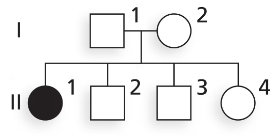
The accompanying pedigree shows a family in which one child (II-1) has an autosomal recessive condition. On the basis of this fact alone, provide the following information.
Pedigree chart showing a family with one child affected by an autosomal recessive condition.
What is the chance that among the three children in generation II who have the dominant phenotype, one of them is AA and two of them are Aa? (Hint: Consider all possible orders of genotypes.)

Guida verificata passo dopo passo
1
Step 1: Understand the inheritance pattern. The condition is autosomal recessive, meaning individuals with the genotype 'aa' have the condition, while individuals with 'AA' or 'Aa' have the dominant phenotype. Parents of the affected child (II-1) must both be carriers (Aa).
Step 2: Determine the probabilities for each genotype in the offspring. Using a Punnett square for two heterozygous parents (Aa x Aa), the probabilities are: 1/4 for 'AA', 1/2 for 'Aa', and 1/4 for 'aa'.
Step 3: Focus on the three children in generation II who have the dominant phenotype. Since 'aa' individuals are excluded, the remaining genotypes are 'AA' and 'Aa'. The probability of being 'AA' is 1/3, and the probability of being 'Aa' is 2/3 (adjusted for the exclusion of 'aa').
Step 4: Calculate the probability of one child being 'AA' and two children being 'Aa'. This involves using the multinomial probability formula: P = (n! / (k1! * k2!)) * (p1^k1) * (p2^k2), where n is the total number of children, k1 and k2 are the counts of each genotype, and p1 and p2 are their respective probabilities.
Step 5: Account for all possible orders of genotypes. Since the order of the children matters, there are multiple arrangements (e.g., 'AA, Aa, Aa', 'Aa, AA, Aa', etc.). Multiply the probability calculated in Step 4 by the number of possible arrangements (which can be determined using permutations).

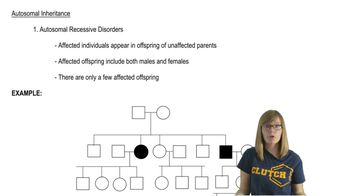
Risposta video verificata per un problema simile:

Questa soluzione video è stata consigliata dai nostri tutor come utile per risolvere questo problema.
Durata del video:
2m

Concetti chiave

Ecco i concetti essenziali che devi comprendere per rispondere correttamente alla domanda.

Autosomal Recessive Inheritance

Autosomal recessive inheritance occurs when a trait is expressed only when an individual has two copies of the recessive allele (aa). Carriers, who have one dominant allele (A) and one recessive allele (a), do not express the condition but can pass the recessive allele to their offspring. Understanding this inheritance pattern is crucial for analyzing the genotypes of individuals in a pedigree.
Video consigliato:
Percorso guidato
09:08
Autosomal Pedigrees

Genotype Probability

Genotype probability involves calculating the likelihood of specific genetic combinations occurring in offspring based on parental genotypes. In this scenario, we need to determine the probability of having one child with the homozygous dominant genotype (AA) and two with the heterozygous genotype (Aa) among the children with a dominant phenotype. This requires applying the principles of probability to genetic outcomes.
Video consigliato:

Order of Genotypes

The order of genotypes refers to the different arrangements in which specific genotypes can occur among a set of individuals. In this case, we must consider all possible sequences of one AA and two Aa children, as the arrangement affects the overall probability. This concept is essential for calculating the total probability of the desired genotype distribution.
Video consigliato:
Percorso guidato
07:52
Gamete Genotypes
Pratica correlata
Domanda del libro di testo

A pea plant that has the genotype RrGgwwdd is crossed to a plant that has the rrGgWwDd genotype. The R gene controls round versus wrinkled seed, the G gene controls yellow versus green seed, the W gene controls purple versus white flower, and the D gene controls tall versus short plants. Determine the following;


What proportion of the progeny are expected to have the genotype rrggwwdd?

487
views
Domanda del libro di testo

A pea plant that has the genotype RrGgwwdd is crossed to a plant that has the rrGgWwDd genotype. The R gene controls round versus wrinkled seed, the G gene controls yellow versus green seed, the W gene controls purple versus white flower, and the D gene controls tall versus short plants. Determine the following;


What are the phenotypes of each plant?

575
views
Domanda del libro di testo

The accompanying pedigree shows a family in which one child (II-1) has an autosomal recessive condition. On the basis of this fact alone, provide the following information.

What are the probabilities for each of the possible genotypes for II-2, II-3, and II-4?

515
views
Domanda del libro di testo

The accompanying pedigree shows a family in which one child (II-1) has an autosomal recessive condition. On the basis of this fact alone, provide the following information.

Using the same alleles, give the possible genotypes for II-2, II-3, and II-4.

776
views
Domanda del libro di testo

A pea plant that has the genotype RrGgwwdd is crossed to a plant that has the rrGgWwDd genotype. The R gene controls round versus wrinkled seed, the G gene controls yellow versus green seed, the W gene controls purple versus white flower, and the D gene controls tall versus short plants. Determine the following;


What proportion of the progeny are expected to have the genotype RrGGwwDd?

432
views
Domanda del libro di testo

The accompanying pedigree shows a family in which one child (II-1) has an autosomal recessive condition. On the basis of this fact alone, provide the following information.

What is the probability that all three of the children in generation II who have the dominant phenotype are Aa?

917
views