Ch. 20 - Population Genetics and Evolution at the Population, Species, and Molecular Levels
Sanders - Genetic Analysis: An Integrated Approach 3rd Edition
Sanders3rd EditionGenetic Analysis: An Integrated ApproachISBN: 9780135564172Non è quello che usi tu?Cambia libro di testo
Capitolo 20, Problema 23

Cystic fibrosis (CF) is the most common autosomal recessive disorder in certain Caucasian populations. In some populations, approximately 1 in 2000 children have CF. Determine the frequency of CF carriers in this population.

Guida verificata passo dopo passo
1
Identify that cystic fibrosis (CF) is an autosomal recessive disorder, meaning two copies of the mutant allele are needed for an individual to express the disease phenotype.
Use the Hardy-Weinberg principle, which states that allele and genotype frequencies in a population will remain constant from generation to generation in the absence of other evolutionary influences.
Define the frequency of the recessive allele (q) as the square root of the incidence of the disease, since the disease is expressed in individuals with the genotype q^2.
Calculate q by taking the square root of the given incidence rate (1/2000).
Determine the carrier frequency (2pq) by first calculating p (the frequency of the dominant allele) as 1 - q, and then using the formula 2pq to find the carrier frequency.

Risposta video verificata per un problema simile:

Questa soluzione video è stata consigliata dai nostri tutor come utile per risolvere questo problema.
Durata del video:
1m

Concetti chiave

Ecco i concetti essenziali che devi comprendere per rispondere correttamente alla domanda.

Autosomal Recessive Inheritance

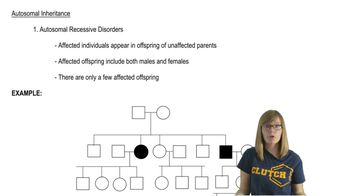
Autosomal recessive inheritance occurs when a trait or disorder is expressed only when an individual has two copies of the recessive allele, one inherited from each parent. Carriers, who have one recessive allele and one dominant allele, do not exhibit the disorder but can pass the recessive allele to their offspring. Understanding this inheritance pattern is crucial for calculating carrier frequencies in populations.
Video consigliato:
Percorso guidato
09:08
Autosomal Pedigrees

Hardy-Weinberg Principle

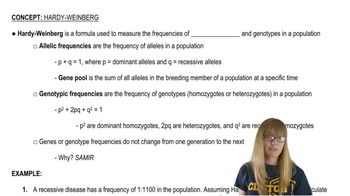
The Hardy-Weinberg principle provides a mathematical framework for understanding genetic variation in a population at equilibrium. It states that allele and genotype frequencies will remain constant from generation to generation in the absence of evolutionary influences. This principle is essential for estimating carrier frequencies and understanding the genetic structure of populations.
Video consigliato:

Carrier Frequency Calculation

Carrier frequency refers to the proportion of individuals in a population who carry one copy of a recessive allele for a genetic disorder. To calculate this for cystic fibrosis, one can use the Hardy-Weinberg equation, where the frequency of the recessive phenotype (CF) helps determine the frequency of carriers. This calculation is vital for understanding the prevalence of genetic disorders in specific populations.
Video consigliato:
Percorso guidato
07:04
Calculating Heritability
Pratica correlata
Domanda del libro di testo

Tay–Sachs disease is an autosomal recessive neurological disorder that is fatal in infancy. Despite its invariably lethal effect, Tay–Sachs disease occurs at very high frequency in some Central and Eastern European (Ashkenazi) Jewish populations. In certain Ashkenazi populations, 1 in 750 infants has Tay–Sachs disease. Population biologists believe the high frequency is a consequence of genetic bottlenecks caused by pogroms (genocide) that have reduced the population multiple times in the past several hundred years. In the population described, what is the frequency of the recessive allele that produces Tay–Sachs disease?

913
views
1
rank
Domanda del libro di testo

Tay–Sachs disease is an autosomal recessive neurological disorder that is fatal in infancy. Despite its invariably lethal effect, Tay–Sachs disease occurs at very high frequency in some Central and Eastern European (Ashkenazi) Jewish populations. In certain Ashkenazi populations, 1 in 750 infants has Tay–Sachs disease. Population biologists believe the high frequency is a consequence of genetic bottlenecks caused by pogroms (genocide) that have reduced the population multiple times in the past several hundred years. Assuming mating occurs at random in this population, what is the probability a couple are both carriers of Tay–Sachs disease?

500
views
Domanda del libro di testo

In the mouse, Mus musculus, survival in agricultural fields that are regularly sprayed with a herbicide is determined by the genotype for a detoxification enzyme encoded by a gene with two alleles, F and S. The relative fitness values for the genotypes are

Why will this pattern of natural selection result in a stable equilibrium of frequencies of F and S?

463
views
Domanda del libro di testo

In the mouse, Mus musculus, survival in agricultural fields that are regularly sprayed with a herbicide is determined by the genotype for a detoxification enzyme encoded by a gene with two alleles, F and S. The relative fitness values for the genotypes are

Calculate the equilibrium frequencies of the alleles.

422
views
Domanda del libro di testo

Tay–Sachs disease is an autosomal recessive neurological disorder that is fatal in infancy. Despite its invariably lethal effect, Tay–Sachs disease occurs at very high frequency in some Central and Eastern European (Ashkenazi) Jewish populations. In certain Ashkenazi populations, 1 in 750 infants has Tay–Sachs disease. Population biologists believe the high frequency is a consequence of genetic bottlenecks caused by pogroms (genocide) that have reduced the population multiple times in the past several hundred years. Explain how a genetic bottleneck and its aftermath could result in a population that carries a lethal allele in high frequency.

552
views
Domanda del libro di testo

In a population of flowers growing in a meadow, C1 and C2 are autosomal codominant alleles that control flower color. The alleles are polymorphic in the population, with f(C1) = 0.80 and f(C2) = 0.20. Flowers that are C1C1 are yellow, orange flowers are C1C2, and C2C2 flowers are red. A storm blows a new species of hungry insects into the meadow, and they begin to eat yellow and orange flowers but not red flowers. The predation exerts strong natural selection on the flower population, resulting in relative fitness values of C1C1 = 0.30, C1C2 = 0.60, and C2C2 = 1.0.

Assuming the population begins in H-W equilibrium, what are the allele frequencies after one generation of natural selection?

490
views