
Ch. 20 - Population Genetics and Evolution at the Population, Species, and Molecular Levels
Sanders - Genetic Analysis: An Integrated Approach 3rd Edition
Sanders3rd EditionGenetic Analysis: An Integrated ApproachISBN: 9780135564172Non è quello che usi tu?Cambia libro di testo
Capitolo 20, Problema 22b

Tay–Sachs disease is an autosomal recessive neurological disorder that is fatal in infancy. Despite its invariably lethal effect, Tay–Sachs disease occurs at very high frequency in some Central and Eastern European (Ashkenazi) Jewish populations. In certain Ashkenazi populations, 1 in 750 infants has Tay–Sachs disease. Population biologists believe the high frequency is a consequence of genetic bottlenecks caused by pogroms (genocide) that have reduced the population multiple times in the past several hundred years. Explain how a genetic bottleneck and its aftermath could result in a population that carries a lethal allele in high frequency.

Guida verificata passo dopo passo
1
A genetic bottleneck occurs when a population undergoes a drastic reduction in size due to events such as natural disasters, disease outbreaks, or human actions like genocide. This reduction limits genetic diversity because only a small subset of individuals survive and reproduce.
During a bottleneck, alleles present in the surviving population may become disproportionately represented, regardless of whether they are beneficial, neutral, or harmful. This is due to random chance rather than natural selection.
If the surviving population includes individuals carrying a lethal recessive allele (such as the Tay–Sachs allele), the frequency of this allele can increase in the population simply because it is present in the reduced gene pool.
After the bottleneck, the population may begin to grow again, but the genetic diversity remains limited. The previously rare lethal allele may persist at a higher frequency because there is less genetic variation to dilute its presence.
In subsequent generations, the allele frequency can remain high, especially if the population remains relatively isolated (e.g., through cultural or geographic factors) and interbreeding within the group continues. This phenomenon is known as genetic drift, which can amplify the effects of the bottleneck over time.

Risposta video verificata per un problema simile:

Questa soluzione video è stata consigliata dai nostri tutor come utile per risolvere questo problema.
Durata del video:
1m

Concetti chiave

Ecco i concetti essenziali che devi comprendere per rispondere correttamente alla domanda.

Genetic Bottleneck

A genetic bottleneck occurs when a population experiences a significant reduction in size due to environmental events or human activities, leading to a loss of genetic diversity. This reduction can result in certain alleles becoming more prevalent in the surviving population, as the genetic variation is limited to the alleles present in the few individuals that survive. Consequently, harmful alleles, such as those causing Tay-Sachs disease, can persist at higher frequencies.
Video consigliato:
Percorso guidato
03:45
Descriptive Genetics

Autosomal Recessive Inheritance

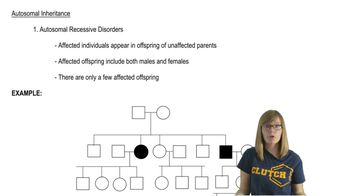
Autosomal recessive inheritance refers to a pattern where two copies of a mutated gene (one from each parent) are necessary for an individual to express a trait or disorder. In the case of Tay-Sachs disease, individuals must inherit the defective allele from both parents to develop the condition. This means that carriers, who possess only one copy of the allele, do not show symptoms but can pass the allele to their offspring, allowing the allele to remain in the population.
Video consigliato:
Percorso guidato
09:08
Autosomal Pedigrees

Founder Effect

The founder effect is a phenomenon that occurs when a small group of individuals establishes a new population, leading to a limited genetic pool. If the founders carry certain alleles, including those for genetic disorders, these alleles can become more common in the new population due to the reduced genetic diversity. In the context of Ashkenazi Jews, historical events that led to population bottlenecks may have resulted in a higher frequency of the Tay-Sachs allele among descendants.
Video consigliato:
Percorso guidato
03:38
Maternal Effect
Pratica correlata
Domanda del libro di testo

The frequency of tasters and nontasters of PTC varies among populations. In population A, 64% of people are tasters (an autosomal dominant trait) and 36% are nontasters. In population B, tasters are 75% and nontasters 25%. In population C, tasters are 91% and nontasters are 9%.

Calculate the frequency of the dominant (T) allele for PTC tasting and the recessive (t) allele for nontasting in each population.

742
views
Domanda del libro di testo

Tay–Sachs disease is an autosomal recessive neurological disorder that is fatal in infancy. Despite its invariably lethal effect, Tay–Sachs disease occurs at very high frequency in some Central and Eastern European (Ashkenazi) Jewish populations. In certain Ashkenazi populations, 1 in 750 infants has Tay–Sachs disease. Population biologists believe the high frequency is a consequence of genetic bottlenecks caused by pogroms (genocide) that have reduced the population multiple times in the past several hundred years. In the population described, what is the frequency of the recessive allele that produces Tay–Sachs disease?

913
views
1
rank
Domanda del libro di testo

Tay–Sachs disease is an autosomal recessive neurological disorder that is fatal in infancy. Despite its invariably lethal effect, Tay–Sachs disease occurs at very high frequency in some Central and Eastern European (Ashkenazi) Jewish populations. In certain Ashkenazi populations, 1 in 750 infants has Tay–Sachs disease. Population biologists believe the high frequency is a consequence of genetic bottlenecks caused by pogroms (genocide) that have reduced the population multiple times in the past several hundred years. Assuming mating occurs at random in this population, what is the probability a couple are both carriers of Tay–Sachs disease?

500
views
Domanda del libro di testo

Tay–Sachs disease is an autosomal recessive neurological disorder that is fatal in infancy. Despite its invariably lethal effect, Tay–Sachs disease occurs at very high frequency in some Central and Eastern European (Ashkenazi) Jewish populations. In certain Ashkenazi populations, 1 in 750 infants has Tay–Sachs disease. Population biologists believe the high frequency is a consequence of genetic bottlenecks caused by pogroms (genocide) that have reduced the population multiple times in the past several hundred years. What is a genetic bottleneck?

800
views
Domanda del libro di testo
Cystic fibrosis (CF) is the most common autosomal recessive disorder in certain Caucasian populations. In some populations, approximately 1 in 2000 children have CF. Determine the frequency of CF carriers in this population.
796
views
Domanda del libro di testo

The frequency of tasters and nontasters of PTC varies among populations. In population A, 64% of people are tasters (an autosomal dominant trait) and 36% are nontasters. In population B, tasters are 75% and nontasters 25%. In population C, tasters are 91% and nontasters are 9%.

Assuming that Hardy–Weinberg conditions apply, determine the genotype frequencies in each population.

1290
views