Ch. 20 - Population Genetics and Evolution at the Population, Species, and Molecular Levels
Sanders - Genetic Analysis: An Integrated Approach 3rd Edition
Sanders3rd EditionGenetic Analysis: An Integrated ApproachISBN: 9780135564172Non è quello che usi tu?Cambia libro di testo
Capitolo 20, Problema D.8

Describe how selection at a locus can result in a loss of polymorphism surrounding the locus.

Guida verificata passo dopo passo
1
Understand that selection at a locus refers to the process where certain alleles increase in frequency because they confer a fitness advantage, while others decrease or are eliminated.
Recognize that when a beneficial allele is strongly favored by selection, it can rapidly increase in frequency and eventually become fixed in the population, meaning all individuals carry that allele.
Know that loci physically close to the selected locus on the chromosome tend to be inherited together due to linkage, a phenomenon called genetic hitchhiking or selective sweep.
Realize that as the beneficial allele rises to fixation, the linked alleles at nearby loci also increase in frequency, reducing genetic variation (polymorphism) in that surrounding region.
Conclude that this reduction in polymorphism occurs because recombination has limited opportunity to separate the beneficial allele from its neighboring alleles during the rapid selective sweep, leading to a loss of diversity around the selected locus.

Risposta video verificata per un problema simile:

Questa soluzione video è stata consigliata dai nostri tutor come utile per risolvere questo problema.
Durata del video:
1m

Concetti chiave

Ecco i concetti essenziali che devi comprendere per rispondere correttamente alla domanda.

Natural Selection and Selective Sweeps

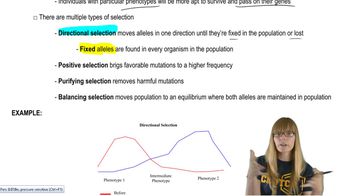
Natural selection favors alleles that increase an organism's fitness, causing these alleles to rise in frequency. When a beneficial mutation at a locus rapidly increases in frequency, it can 'sweep' through the population, reducing genetic variation at nearby linked loci, a process known as a selective sweep.
Video consigliato:
Percorso guidato
05:54
Natural Selection

Genetic Linkage and Linkage Disequilibrium

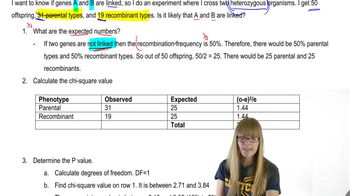
Genetic linkage refers to the physical proximity of genes on a chromosome, which affects their likelihood of being inherited together. Linkage disequilibrium occurs when alleles at different loci are non-randomly associated, so selection at one locus can indirectly reduce variation at linked loci.
Video consigliato:
Percorso guidato
07:33
Chi Square and Linkage

Polymorphism and Genetic Variation

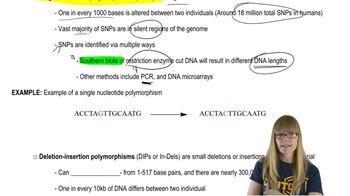
Polymorphism is the presence of two or more alleles at a locus within a population. Genetic variation is essential for evolution, but strong selection at one locus can reduce polymorphism nearby by favoring one allele and eliminating others, leading to a loss of diversity in that genomic region.
Video consigliato:
Percorso guidato
09:28
Genomic Variation