Ch. 20 - Population Genetics and Evolution at the Population, Species, and Molecular Levels
Sanders - Genetic Analysis: An Integrated Approach 3rd Edition
Sanders3rd EditionGenetic Analysis: An Integrated ApproachISBN: 9780135564172Non è quello che usi tu?Cambia libro di testo
Capitolo 20, Problema D.5

How do copy-number variants arise? Do they account for more polymorphism than SNPs within the human population?

Guida verificata passo dopo passo
1
Understand what copy-number variants (CNVs) are: CNVs are segments of DNA that are duplicated or deleted, resulting in a variable number of copies of that segment between individuals in a population.
Learn the mechanisms by which CNVs arise: CNVs typically arise through errors during DNA replication or repair, such as non-allelic homologous recombination (NAHR), non-homologous end joining (NHEJ), or replication fork stalling and template switching (FoSTeS).
Compare CNVs to single nucleotide polymorphisms (SNPs): SNPs are single base-pair changes in the DNA sequence, while CNVs involve larger segments of DNA that can range from kilobases to megabases in size.
Evaluate the contribution of CNVs to genetic polymorphism: Although SNPs are more numerous in terms of count, CNVs can affect larger portions of the genome and thus contribute more to the total amount of genetic variation between individuals.
Summarize the relative impact: CNVs account for a significant portion of genetic diversity and structural variation in the human genome, often exceeding the amount of polymorphism caused by SNPs when considering the total DNA sequence affected.

Risposta video verificata per un problema simile:

Questa soluzione video è stata consigliata dai nostri tutor come utile per risolvere questo problema.
Durata del video:
2m

Concetti chiave

Ecco i concetti essenziali che devi comprendere per rispondere correttamente alla domanda.

Copy-Number Variants (CNVs)

CNVs are segments of DNA that vary in copy number between individuals, involving deletions or duplications of large genomic regions. They arise through mechanisms like unequal crossing over during meiosis, replication errors, or DNA repair processes, leading to structural variation in the genome.
Video consigliato:
Percorso guidato
08:42
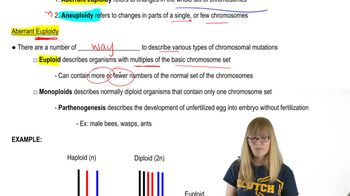
Aberrant Euploid

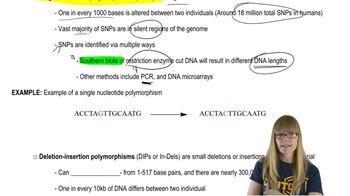
Single Nucleotide Polymorphisms (SNPs)

SNPs are the most common type of genetic variation, involving a change of a single nucleotide base in the DNA sequence. Although individually small, SNPs are abundant throughout the genome and serve as important markers for genetic diversity and association studies.
Video consigliato:
Percorso guidato
03:51
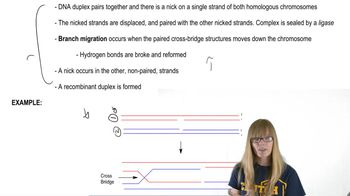
Recombination after Single Strand Breaks

Genetic Polymorphism and Variation

Genetic polymorphism refers to the presence of two or more variants (alleles) at a locus within a population. Understanding the relative contribution of CNVs and SNPs to polymorphism helps clarify the extent and impact of structural versus single-base genetic diversity in humans.
Video consigliato:
Percorso guidato
09:28
Genomic Variation