Genetic drift, an evolutionary process affecting all populations, can have a significant effect in small populations, even though its effect is negligible in large populations. Explain why this is the case.
Ch. 20 - Population Genetics and Evolution at the Population, Species, and Molecular Levels

Sanders3rd EditionGenetic Analysis: An Integrated ApproachISBN: 9780135564172Non è quello che usi tu?Cambia libro di testo
Tutti i libri di testo
Sanders 3rd Edition
Ch. 20 - Population Genetics and Evolution at the Population, Species, and Molecular Levels
Problema 5
Sanders 3rd Edition
Ch. 20 - Population Genetics and Evolution at the Population, Species, and Molecular Levels
Problema 5Capitolo 20, Problema 5
Thinking creatively about evolutionary mechanisms, identify at least two schemes that could generate allelic polymorphism in a population. Do not include the processes described in the answer to Problem 4.
Guida verificata passo dopo passo1
Step 1: Understand the concept of allelic polymorphism, which refers to the presence of two or more alleles at a locus within a population, contributing to genetic diversity.
Step 2: Recall that evolutionary mechanisms generating allelic polymorphism include mutation, natural selection, gene flow, genetic drift, and recombination, but exclude those mentioned in Problem 4 as per the instructions.
Step 3: Consider mutation as one scheme: random changes in DNA sequences introduce new alleles into the population, increasing allelic variation over time.
Step 4: Consider balancing selection as another scheme: this includes mechanisms like heterozygote advantage or frequency-dependent selection, which maintain multiple alleles in the population by favoring genetic diversity.
Step 5: Summarize that both mutation (introducing new alleles) and balancing selection (maintaining multiple alleles) are key evolutionary schemes that can generate and sustain allelic polymorphism in populations.

Risposta video verificata per un problema simile:
Questa soluzione video è stata consigliata dai nostri tutor come utile per risolvere questo problema.
Durata del video:
2mConcetti chiave
Ecco i concetti essenziali che devi comprendere per rispondere correttamente alla domanda.
Allelic Polymorphism
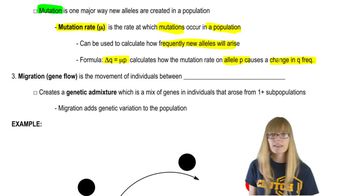
Allelic polymorphism refers to the presence of two or more different alleles at a gene locus within a population. This genetic variation is essential for evolution and adaptation, as it provides the raw material for natural selection to act upon.
Video consigliato:
Percorso guidato
New Alleles and Migration
Balancing Selection
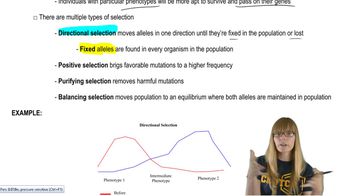
Balancing selection is an evolutionary mechanism that maintains multiple alleles in a population by providing a selective advantage to heterozygotes or through frequency-dependent selection. This process helps preserve genetic diversity and can generate stable allelic polymorphism.
Video consigliato:
Percorso guidato
Natural Selection
Mutation and Gene Flow
Mutation introduces new alleles into a population by altering DNA sequences, while gene flow involves the transfer of alleles between populations through migration. Both mechanisms increase genetic variation and can contribute to the generation and maintenance of allelic polymorphism.
Video consigliato:
Percorso guidato
Cancer Mutations
Pratica correlata
Domanda del libro di testo
764
views
Domanda del libro di testo
Discuss how both gains and losses of regulatory elements may lead to human-specific traits.
486
views
Domanda del libro di testo
Consider possible societal and ethical dilemmas that might arise if we currently shared the planet with another hominin.
529
views
Domanda del libro di testo
How do copy-number variants arise? Do they account for more polymorphism than SNPs within the human population?
514
views
Domanda del libro di testo
What lines of evidence support the hypothesis that modern humans evolved in Africa and then subsequently migrated throughout the globe?
576
views
Domanda del libro di testo
Describe how natural selection can produce balanced polymorphism of allele frequencies through selection that favors heterozygotes.
545
views