Ch. 20 - Population Genetics and Evolution at the Population, Species, and Molecular Levels
Sanders - Genetic Analysis: An Integrated Approach 3rd Edition
Sanders3rd EditionGenetic Analysis: An Integrated ApproachISBN: 9780135564172Non è quello che usi tu?Cambia libro di testo
Capitolo 20, Problema D.11

In Island Melanesia and Polynesia, most mtDNA haplotypes are of Asian ancestry, whereas Y chromosome haplotypes are predominantly New Guinean. Provide a hypothesis for this sex-biased distribution.

Guida verificata passo dopo passo
1
Understand the biological basis of mtDNA and Y chromosome inheritance: mtDNA is maternally inherited, meaning it is passed down from mothers to their offspring, while the Y chromosome is paternally inherited, passed from fathers to sons.
Recognize that the observed pattern—Asian ancestry in mtDNA and New Guinean ancestry in Y chromosomes—suggests different migration or mating patterns for males and females in these populations.
Formulate a hypothesis that could explain this sex-biased distribution, such as a scenario where Asian women migrated and integrated into New Guinean male populations, leading to Asian mtDNA lineages and New Guinean Y chromosome lineages.
Consider historical or anthropological factors that might support this hypothesis, such as patrilocality (where women move to the husband's community), male-biased local residence, or differential migration routes for men and women.
Summarize the hypothesis by linking the genetic evidence to social or demographic behaviors that result in the observed pattern of Asian mtDNA and New Guinean Y chromosome haplotypes.

Risposta video verificata per un problema simile:

Questa soluzione video è stata consigliata dai nostri tutor come utile per risolvere questo problema.
Durata del video:
3m

Concetti chiave

Ecco i concetti essenziali che devi comprendere per rispondere correttamente alla domanda.

Mitochondrial DNA (mtDNA) Inheritance

mtDNA is inherited exclusively from the mother, making it a useful marker for tracing maternal ancestry. Because it does not recombine, mtDNA haplotypes reflect maternal lineage and migration patterns over generations.
Video consigliato:
Percorso guidato
05:13
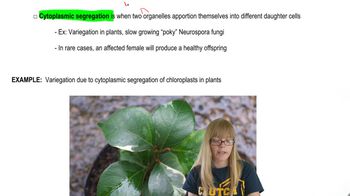
Organelle Inheritance

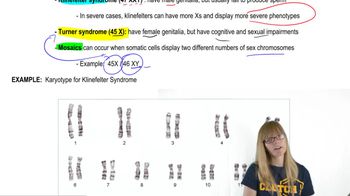
Y Chromosome Inheritance

The Y chromosome is passed from father to son, serving as a marker for paternal ancestry. Its haplotypes reveal male lineage and can show different migration or admixture patterns compared to maternal markers.
Video consigliato:
Percorso guidato
10:35
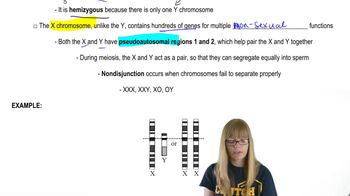
Human Sex Chromosomes

Sex-Biased Gene Flow and Migration

Sex-biased gene flow occurs when males and females contribute differently to the gene pool due to cultural practices like patrilocality or matrilocality, or historical migration events. This can lead to contrasting patterns in mtDNA and Y chromosome distributions.
Video consigliato:
Percorso guidato
07:56
Sex-Linked Genes
Pratica correlata
Domanda del libro di testo
Biologists have proposed that the use of antibiotics to treat human infectious disease has played a role in the evolution of widespread antibiotic resistance in several bacterial species, including Staphylococcus aureus and the bacteria causing gonorrhea, tuberculosis, and other infectious diseases. Explain how the evolutionary mechanisms mutation and natural selection may have contributed to the development of antibiotic resistance.
487
views
Domanda del libro di testo

The ability to taste the bitter compound phenylthiocarbamide (PTC) is an autosomal dominant trait. The inability to taste PTC is a recessive condition. In a sample of 500 people, 360 have the ability to taste PTC and 140 do not. Calculate the frequency of each genotype.

1237
views
Domanda del libro di testo

When the human genome is examined, the chromosomes appear to have undergone only minimal rearrangement in the 100 million years since the last common ancestor of eutherian mammals. However, when individual humans are examined or when the human genome is compared with that of chimpanzees, a large number of small indels and SNPs can be detected. How are these observations reconciled?

535
views
Domanda del libro di testo

The figure illustrates the effect of an ethanol-rich and an ethanol-free environment on the frequency of the Drosophila AdhF allele in four populations in a 50-generation laboratory experiment. Population 1 and population 2 were reared for 50 generations in a high-ethanol environment, while control 1 and control 2 populations were reared for 50 generations in a zero-ethanol environment. Describe the effect of each environment on the populations, and state any conclusions you can reach about the role of any of the evolutionary processes in producing these effects.

498
views
Domanda del libro di testo

A 9-bp deletion in the mitochondrial genome between the gene for cytochrome oxidase subunit II and the gene for tRNAᴸʸˢ is a common polymorphism among Polynesians and also in a population of Taiwanese natives. The frequency of the polymorphism varies between populations: The highest frequency is seen in the Maoris of New Zealand (98%), lower levels are seen in eastern Polynesia (80%) and western Polynesia (89%), and the lowest level is seen in the Taiwanese population. What do these frequencies tell us about the settlement of the Pacific by the ancestors of the present-day Polynesians?

437
views
Domanda del libro di testo

The ability to taste the bitter compound phenylthiocarbamide (PTC) is an autosomal dominant trait. The inability to taste PTC is a recessive condition. In a sample of 500 people, 360 have the ability to taste PTC and 140 do not. Calculate the frequency of the dominant allele.

465
views