Ch. 5 - Genetic Linkage and Mapping in Eukaryotes
Sanders - Genetic Analysis: An Integrated Approach 3rd Edition
Sanders3rd EditionGenetic Analysis: An Integrated ApproachISBN: 9780135564172Non è quello che usi tu?Cambia libro di testo
Capitolo 5, Problema 19a

Genetic linkage mapping for a large number of families identifies 4% recombination between the genes for Rh blood type and elliptocytosis (see Problem 18). At the Rh locus, alleles R and r control Rh+ and Rh- blood types. Allele E producing elliptocytosis is dominant to the wild-type recessive allele e. Tom and Terri each have elliptocytosis, and each is . Tom's mother has elliptocytosis and is Rh- while his father is healthy and has Rh+. Terri's father is Rh+ and has elliptocytosis; Terri's mother is Rh- and is healthy.


What is the probability that the first child of Tom and Terri will be Rh− and have elliptocytosis?

Guida verificata passo dopo passo
1
Step 1: Understand the genetic linkage and recombination frequency. The problem states a 4% recombination frequency between the Rh blood type gene and the elliptocytosis gene. This means the genes are linked and close together on the same chromosome, with a low probability of recombination occurring between them during meiosis.
Step 2: Determine the genotypes of Tom and Terri based on their family information. Tom's mother is Rh- and has elliptocytosis, while his father is Rh+ and healthy. This suggests Tom inherited Rh- from his mother and Rh+ from his father, making him heterozygous (Rr). For elliptocytosis, Tom inherited the dominant allele E from his mother and the recessive allele e from his father, making him heterozygous (Ee). Similarly, Terri's father is Rh+ and has elliptocytosis, while her mother is Rh- and healthy. This suggests Terri is also heterozygous for both traits (Rr and Ee).
Step 3: Set up a Punnett square for the Rh blood type gene (Rr x Rr). This will help determine the probabilities of the offspring being Rh+ (RR or Rr) or Rh- (rr). The possible genotypes are RR, Rr, and rr, with a 25% chance of being Rh- (rr).
Step 4: Set up a Punnett square for the elliptocytosis gene (Ee x Ee). This will help determine the probabilities of the offspring having elliptocytosis (EE or Ee) or being healthy (ee). The possible genotypes are EE, Ee, and ee, with a 75% chance of having elliptocytosis (EE or Ee).
Step 5: Combine the probabilities from the two Punnett squares, considering the genetic linkage and recombination frequency. Since the genes are linked, the probability of Rh- and elliptocytosis must account for the 4% recombination rate. Multiply the probabilities of Rh- (25%) and elliptocytosis (75%), then adjust for the recombination frequency to calculate the final probability.

Risposta video verificata per un problema simile:

Questa soluzione video è stata consigliata dai nostri tutor come utile per risolvere questo problema.
Durata del video:
2m

Concetti chiave

Ecco i concetti essenziali che devi comprendere per rispondere correttamente alla domanda.

Genetic Linkage and Recombination

Genetic linkage refers to the tendency of genes located close to each other on a chromosome to be inherited together. Recombination occurs during meiosis, where homologous chromosomes exchange genetic material, leading to new allele combinations. The percentage of recombination, such as the 4% mentioned, indicates the likelihood that two genes will assort independently, which is crucial for predicting offspring genotypes.
Video consigliato:
Percorso guidato
07:33
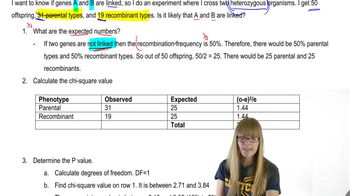
Chi Square and Linkage

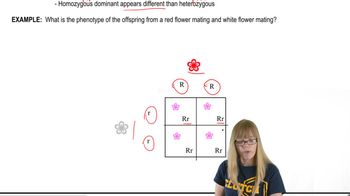
Alleles and Dominance

Alleles are different forms of a gene that can exist at a specific locus on a chromosome. In this scenario, the Rh blood type is determined by alleles R (Rh+) and r (Rh-), while elliptocytosis is controlled by the dominant allele E and the recessive allele e. Understanding dominance is essential for predicting phenotypes in offspring based on parental genotypes.
Video consigliato:
Percorso guidato
04:37
Variations on Dominance

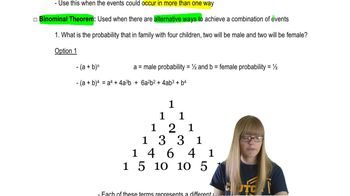
Punnett Squares and Probability

A Punnett square is a tool used to predict the genotypes of offspring from parental crosses. By filling in the square with the possible gametes from each parent, one can calculate the probabilities of various genotypes and phenotypes in the offspring. This method is particularly useful in this question to determine the likelihood of the child being Rh− and having elliptocytosis based on the parents' genotypes.
Video consigliato:
Pratica correlata
Domanda del libro di testo

Gene R and gene T are genetically linked. Answer the following questions concerning a dihybrid organism with the genotype Rt/rT:


If r = 0.20, give the expected frequencies of gametes produced by the dihybrid.

492
views
Domanda del libro di testo

The Rh blood group in humans is determined by a gene on chromosome 1. A dominant allele produces Rh+ blood type, and a recessive allele generates Rh-. Elliptocytosis is an autosomal dominant disorder that produces abnormally shaped red blood cells that have a short life span resulting in hereditary anemia. A large family with elliptocytosis is tested for genetic linkage of Rh blood group and the disease. The lod score data below are obtained for the family.

Over what range of θ do lod scores indicate significant evidence in favor of genetic linkage?

550
views
Domanda del libro di testo

A group of families in which an autosomal dominant condition is present are studied to determine lod scores for possible genetic linkage between three RFLP markers (R1, R2, and R3) and the disease gene. The chart shows lod scores at each of the recombination distances (θ values) tested. Provide an interpretation of the lod score results for each RFLP. Be specific about any significant evidence of genetic linkage.

441
views
Domanda del libro di testo

Genetic linkage mapping for a large number of families identifies 4% recombination between the genes for Rh blood type and elliptocytosis (see Problem 18). At the Rh locus, alleles R and r control Rh+ and Rh- blood types. Allele E producing elliptocytosis is dominant to the wild-type recessive allele e. Tom and Terri each have elliptocytosis, and each is . Tom's mother has elliptocytosis and is Rh- while his father is healthy and has Rh+. Terri's father is Rh+ and has elliptocytosis; Terri's mother is Rh- and is healthy.


What is the probability that a child of Tom and Terri who is Rh+ will have elliptocytosis?

750
views
Domanda del libro di testo

The Rh blood group in humans is determined by a gene on chromosome 1. A dominant allele produces Rh+ blood type, and a recessive allele generates Rh-. Elliptocytosis is an autosomal dominant disorder that produces abnormally shaped red blood cells that have a short life span resulting in hereditary anemia. A large family with elliptocytosis is tested for genetic linkage of Rh blood group and the disease. The lod score data below are obtained for the family.

What is Zₘₐₓ for this family? 

567
views
Domanda del libro di testo

The Rh blood group in humans is determined by a gene on chromosome 1. A dominant allele produces Rh+ blood type, and a recessive allele generates Rh-. Elliptocytosis is an autosomal dominant disorder that produces abnormally shaped red blood cells that have a short life span resulting in hereditary anemia. A large family with elliptocytosis is tested for genetic linkage of Rh blood group and the disease. The lod score data below are obtained for the family.

From these data, can you conclude that Rh and elliptocytosis loci are genetically linked in this family? Why or why not?

596
views