Ch. 6 - Genetic Analysis and Mapping in Bacteria and Bacteriophages
Sanders - Genetic Analysis: An Integrated Approach 3rd Edition
Sanders3rd EditionGenetic Analysis: An Integrated ApproachISBN: 9780135564172Non è quello che usi tu?Cambia libro di testo
Capitolo 6, Problema 10

Describe the differences between genetic complementation and recombination as they relate to the detection of wild-type lysis by a mutant bacteriophage.

Guida verificata passo dopo passo
1
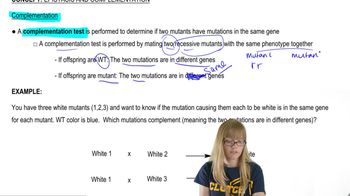
Understand the concept of genetic complementation: Genetic complementation occurs when two different mutations in the genome of an organism (or virus, in this case) are brought together in the same cell, and the functional product of one mutation compensates for the defect caused by the other mutation. This allows the organism or virus to exhibit a wild-type phenotype, such as lysis in bacteriophages.
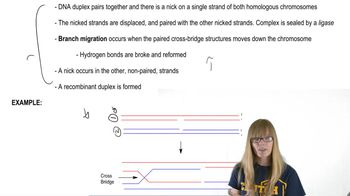
Understand the concept of recombination: Recombination involves the physical exchange of genetic material between two DNA molecules, resulting in new combinations of alleles. In bacteriophages, recombination can produce a wild-type genotype by combining non-mutated regions from two mutant genomes.
Relate complementation to wild-type lysis detection: In the case of bacteriophages, complementation can be tested by co-infecting a bacterial host with two mutant phages. If the mutations affect different genes, the phages can complement each other, leading to wild-type lysis of the host cell.
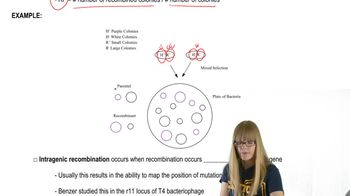
Relate recombination to wild-type lysis detection: Recombination can be detected by co-infecting a bacterial host with two mutant phages and analyzing the progeny phages. If recombination occurs, some progeny may inherit a wild-type genotype, leading to wild-type lysis of the host cell.
Compare the mechanisms: Complementation involves functional interaction between gene products without altering the genetic material, while recombination physically alters the genetic material to produce new genotypes. Both processes can result in wild-type lysis, but they are fundamentally different in their mechanisms and detection methods.

Risposta video verificata per un problema simile:

Questa soluzione video è stata consigliata dai nostri tutor come utile per risolvere questo problema.
Durata del video:
2m

Concetti chiave

Ecco i concetti essenziali che devi comprendere per rispondere correttamente alla domanda.

Genetic Complementation

Genetic complementation occurs when two different mutations in a gene are present in the same organism, and the wild-type phenotype is restored. This process is often used to determine whether two mutations affect the same gene or different genes. In the context of bacteriophages, complementation can help identify whether a mutant phage can produce wild-type lysis when paired with another phage carrying a functional copy of the gene.
Video consigliato:
Percorso guidato
05:05
Complementation

Recombination

Recombination is a genetic process where genetic material is exchanged between different DNA molecules, leading to new combinations of alleles. In bacteriophages, recombination can occur during co-infection of a host cell by two different phages, resulting in progeny that may exhibit wild-type characteristics if the exchanged genetic material includes functional genes. This process is crucial for understanding genetic diversity and the evolution of phages.
Video consigliato:
Percorso guidato
03:51
Recombination after Single Strand Breaks

Bacteriophage Lysis

Bacteriophage lysis refers to the process by which a bacteriophage infects a bacterial cell and ultimately causes its destruction, releasing new phage particles. The ability of a phage to induce lysis is often used as a measure of its virulence and functionality. In experiments involving mutants, observing lysis can indicate whether the mutations affect essential lytic functions, which can be analyzed through complementation and recombination studies.
Video consigliato:
Percorso guidato
06:04
Mapping Bacteriophages