Among the mechanisms of gene transfer in bacteria, which one is capable of transferring the largest chromosome segment from donor to recipient? Which process generally transfers the smallest donor segments to the recipient? Explain your reasoning for both answers.
Ch. 6 - Genetic Analysis and Mapping in Bacteria and Bacteriophages

Sanders3rd EditionGenetic Analysis: An Integrated ApproachISBN: 9780135564172Non è quello che usi tu?Cambia libro di testo
Tutti i libri di testo
Sanders 3rd Edition
Ch. 6 - Genetic Analysis and Mapping in Bacteria and Bacteriophages
Problema 9
Sanders 3rd Edition
Ch. 6 - Genetic Analysis and Mapping in Bacteria and Bacteriophages
Problema 9Capitolo 6, Problema 9
How is the frequency of cotransduction related to the relative positions of genes on a bacterial chromosome? Draw a map of three genes and describe the expected relationship of cotransduction frequencies to the map.
Guida verificata passo dopo passo1
Understand the concept of cotransduction: Cotransduction refers to the simultaneous transfer of two or more genes from a donor bacterium to a recipient bacterium via a bacteriophage. This process occurs when the genes are close enough on the bacterial chromosome to be packaged into the same phage particle during transduction.
Explain the relationship between cotransduction frequency and gene distance: The frequency of cotransduction is inversely proportional to the distance between genes on the bacterial chromosome. Genes that are closer together are more likely to be cotransduced because they are more likely to fit within the same fragment of DNA packaged by the bacteriophage.
Draw a hypothetical gene map: Consider three genes (A, B, and C) on a bacterial chromosome. Assume the relative positions are as follows: A and B are close together, while C is farther away from both A and B. The map could be represented as: A---B----------------C, where the dashes represent relative distances.
Describe the expected cotransduction frequencies: Based on the map, the cotransduction frequency between A and B will be higher because they are closer together. The cotransduction frequency between A and C, as well as between B and C, will be lower because C is farther away from both A and B.
Summarize the relationship: The closer two genes are on the bacterial chromosome, the higher their cotransduction frequency. This relationship can be used to infer the relative positions of genes and construct genetic maps based on experimental cotransduction data.

Risposta video verificata per un problema simile:
Questa soluzione video è stata consigliata dai nostri tutor come utile per risolvere questo problema.
Durata del video:
1mConcetti chiave
Ecco i concetti essenziali che devi comprendere per rispondere correttamente alla domanda.
Cotransduction
Cotransduction is a genetic phenomenon where two or more genes are transferred together from one bacterium to another via a bacteriophage. The likelihood of cotransduction occurring is influenced by the physical proximity of the genes on the bacterial chromosome. Genes that are closer together are more likely to be packaged into the same viral particle, leading to higher cotransduction frequencies.
Video consigliato:
Percorso guidato
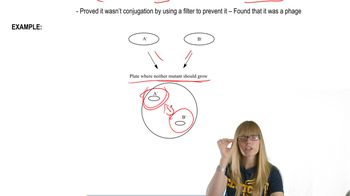
Transduction
Gene Mapping
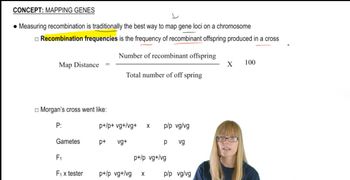
Gene mapping involves determining the relative positions of genes on a chromosome. In bacteria, this is often done using cotransduction frequencies as a measure of distance between genes. By analyzing how often two genes are cotransduced, researchers can infer their relative locations, with closer genes showing higher cotransduction rates.
Video consigliato:
Percorso guidato
Mapping Genes
Bacterial Chromosome Structure
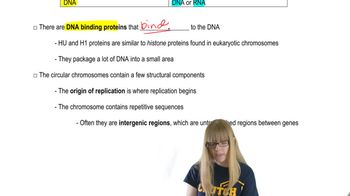
Bacterial chromosomes are typically circular and contain genes arranged in a linear order. The structure of the chromosome affects gene expression and the likelihood of genetic recombination events, such as cotransduction. Understanding the organization of genes on the chromosome is crucial for predicting the outcomes of genetic experiments and the relationships between gene positions.
Video consigliato:
Percorso guidato
Bacteria and Viral Chromosome Structure
Pratica correlata
Domanda del libro di testo
644
views
Domanda del libro di testo
Describe the differences between genetic complementation and recombination as they relate to the detection of wild-type lysis by a mutant bacteriophage.
824
views
Domanda del libro di testo
Describe what is meant by the term site-specific recombination as used in identifying the processes that lead to the integration of temperate bacteriophages into host bacterial chromosomes during lysogeny or to the formation of specialized transducing phage.
483
views
Domanda del libro di testo
What is a prophage, and how is a prophage formed?
1309
views
Domanda del libro di testo
Describe the difference between the bacteriophage lytic cycle and lysogenic cycle.
457
views
Domanda del libro di testo
What is lateral gene transfer? How might it take place between two bacterial cells?
626
views