Ch. 6 - Genetic Analysis and Mapping in Bacteria and Bacteriophages
Sanders - Genetic Analysis: An Integrated Approach 3rd Edition
Sanders3rd EditionGenetic Analysis: An Integrated ApproachISBN: 9780135564172Non è quello che usi tu?Cambia libro di testo
Capitolo 6, Problema 5e

Explain the importance of the following features in conjugating donor bacteria:
relaxase

Guida verificata passo dopo passo
1
Understand that conjugation is a process of horizontal gene transfer in bacteria, where genetic material is transferred from a donor cell to a recipient cell through direct contact.
Recognize that relaxase is an enzyme essential for initiating the transfer of DNA during bacterial conjugation. It is part of the relaxosome complex, which processes the DNA at the origin of transfer (oriT).
Learn that relaxase performs a site-specific cleavage at the oriT sequence of the plasmid DNA in the donor cell. This cleavage creates a single-stranded DNA (ssDNA) that is ready for transfer.
Understand that relaxase remains attached to the ssDNA and guides it through the conjugation machinery, such as the type IV secretion system, into the recipient cell.
Appreciate the importance of relaxase in ensuring the accurate and efficient transfer of genetic material, which contributes to genetic diversity and the spread of traits like antibiotic resistance among bacterial populations.

Risposta video verificata per un problema simile:

Questa soluzione video è stata consigliata dai nostri tutor come utile per risolvere questo problema.
Durata del video:
2m

Concetti chiave

Ecco i concetti essenziali che devi comprendere per rispondere correttamente alla domanda.

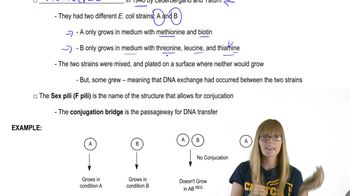
Conjugation

Conjugation is a process of horizontal gene transfer in bacteria, where genetic material is transferred from a donor to a recipient cell through direct contact. This mechanism is crucial for the spread of antibiotic resistance and other traits among bacterial populations. Understanding conjugation helps in grasping how genetic diversity is generated in microbial communities.
Video consigliato:
Percorso guidato
04:06
Conjugation Overview

Relaxase

Relaxase is an enzyme that plays a critical role in the conjugation process by facilitating the transfer of plasmid DNA from the donor to the recipient bacterium. It acts by unwinding the plasmid DNA and creating a single-stranded DNA (ssDNA) molecule that can be transferred. The activity of relaxase is essential for the successful establishment of genetic material in the recipient cell.

Plasmids

Plasmids are small, circular DNA molecules that exist independently of chromosomal DNA in bacteria. They often carry genes that confer advantageous traits, such as antibiotic resistance or virulence factors. In the context of conjugation, plasmids are the primary vehicles for gene transfer, making their understanding vital for studying bacterial genetics and evolution.
Video consigliato: