Ch. 6 - Genetic Analysis and Mapping in Bacteria and Bacteriophages
Sanders - Genetic Analysis: An Integrated Approach 3rd Edition
Sanders3rd EditionGenetic Analysis: An Integrated ApproachISBN: 9780135564172Non è quello che usi tu?Cambia libro di testo
Capitolo 6, Problema 1c

For bacteria that are F⁺, Hfr, F', and F⁻ perform or answer the following.
Which of these donors can convert exconjugants to a donor state?

Guida verificata passo dopo passo
1
Understand the types of bacterial cells involved: F⁺ cells contain the F plasmid, which allows them to act as donors during conjugation. Hfr cells have the F plasmid integrated into their chromosome, enabling high-frequency recombination. F' cells contain the F plasmid with additional chromosomal genes, and F⁻ cells lack the F plasmid and cannot act as donors.
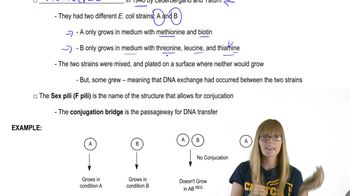
Recall the process of bacterial conjugation: During conjugation, the donor cell transfers genetic material to the recipient cell through a pilus. The ability to convert exconjugants to a donor state depends on whether the F plasmid or its equivalent is transferred.
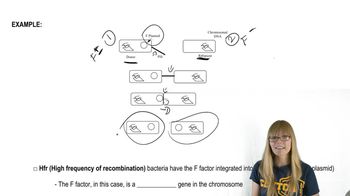
Analyze the F⁺ cells: F⁺ cells can transfer the F plasmid to F⁻ cells during conjugation, converting them into F⁺ cells, which are capable of acting as donors.
Analyze the Hfr cells: Hfr cells transfer chromosomal genes during conjugation, but they typically do not transfer the entire F plasmid. As a result, exconjugants usually remain F⁻ and cannot act as donors.
Analyze the F' cells: F' cells can transfer the F' plasmid (which includes the F plasmid and additional chromosomal genes) to F⁻ cells during conjugation, converting them into F' cells, which are capable of acting as donors.

Risposta video verificata per un problema simile:

Questa soluzione video è stata consigliata dai nostri tutor come utile per risolvere questo problema.
Durata del video:
3m

Concetti chiave

Ecco i concetti essenziali che devi comprendere per rispondere correttamente alla domanda.

Conjugation in Bacteria

Conjugation is a process of genetic transfer in bacteria where one bacterium transfers genetic material to another through direct contact. This typically involves a donor cell (F⁺ or Hfr) and a recipient cell (F⁻). The donor's plasmid or chromosomal DNA can be transferred, leading to genetic recombination in the recipient.
Video consigliato:
Percorso guidato
04:06
Conjugation Overview

F⁺ and F' Strains

F⁺ strains contain a fertility factor (F plasmid) that allows them to initiate conjugation. F' strains are derived from F⁺ strains but carry additional chromosomal genes along with the F plasmid. Both types can convert F⁻ recipients into F⁺ donors through the transfer of the F plasmid during conjugation.
Video consigliato:
Percorso guidato
08:52
F Factor and Hfr

Hfr Strains

Hfr (High-frequency recombination) strains have the F plasmid integrated into their chromosomal DNA. During conjugation, they can transfer chromosomal genes to a recipient, which may lead to the recipient acquiring donor characteristics. However, Hfr strains typically do not convert recipients to donor states unless the entire F plasmid is transferred, which is rare.
Video consigliato:
Percorso guidato
08:52
F Factor and Hfr