Ch. 6 - Genetic Analysis and Mapping in Bacteria and Bacteriophages
Sanders - Genetic Analysis: An Integrated Approach 3rd Edition
Sanders3rd EditionGenetic Analysis: An Integrated ApproachISBN: 9780135564172Non è quello che usi tu?Cambia libro di testo
Capitolo 6, Problema 1d

For bacteria that are F⁺, Hfr, F', and F⁻, perform or answer the following.
Which of these donors can transfer a donor gene to exconjugants?

Guida verificata passo dopo passo
1
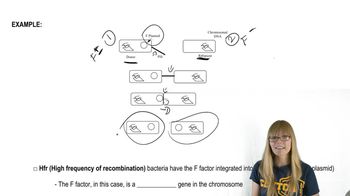
Understand the types of bacterial cells involved: F⁺ cells contain the F plasmid (fertility factor) in its free form, Hfr cells have the F plasmid integrated into their chromosome, F' cells have the F plasmid with additional bacterial genes, and F⁻ cells lack the F plasmid entirely.
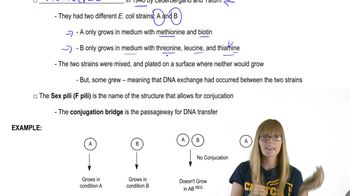
Recall the mechanism of conjugation: Conjugation is the process by which genetic material is transferred from a donor cell to a recipient cell through direct contact. The donor cell must have the F plasmid to initiate this process.
Determine the ability of each type of donor to transfer genes: F⁺ cells can transfer the F plasmid itself, Hfr cells can transfer chromosomal genes (due to the integrated F plasmid), and F' cells can transfer the F plasmid along with additional bacterial genes. F⁻ cells cannot act as donors because they lack the F plasmid.
Focus on the transfer of donor genes: Hfr cells are particularly effective at transferring donor genes because the F plasmid is integrated into their chromosome, allowing chromosomal genes to be transferred during conjugation. F' cells can also transfer donor genes, but these are limited to the genes carried on the F' plasmid.
Conclude which donors can transfer donor genes: Based on the above, Hfr and F' cells are capable of transferring donor genes to exconjugants, while F⁺ cells primarily transfer the F plasmid itself, and F⁻ cells cannot transfer any genetic material.

Risposta video verificata per un problema simile:

Questa soluzione video è stata consigliata dai nostri tutor come utile per risolvere questo problema.
Durata del video:
4m

Concetti chiave

Ecco i concetti essenziali che devi comprendere per rispondere correttamente alla domanda.

Conjugation in Bacteria

Conjugation is a process of genetic transfer in bacteria where one bacterium transfers genetic material to another through direct contact. This typically involves a donor cell (F⁺ or Hfr) and a recipient cell (F⁻). The process is crucial for horizontal gene transfer, allowing for genetic diversity and adaptation in bacterial populations.
Video consigliato:
Percorso guidato
04:06
Conjugation Overview

F⁺ and Hfr Strains

F⁺ strains contain a fertility factor (F) that allows them to initiate conjugation and transfer genes to F⁻ recipients. Hfr (high frequency of recombination) strains have the F factor integrated into their chromosome, enabling them to transfer chromosomal genes during conjugation. Both types can effectively donate genes to exconjugants.
Video consigliato:
Percorso guidato
08:52
F Factor and Hfr

F' Strains

F' strains are derived from Hfr strains when the F factor excises from the chromosome, sometimes carrying adjacent chromosomal genes with it. These strains can transfer both the F factor and the additional genes to F⁻ recipients during conjugation. This unique capability allows for the transfer of donor genes to exconjugants, making F' strains significant in genetic studies.
Video consigliato:
Percorso guidato
08:52
F Factor and Hfr