Ch. 7 - DNA Structure and Replication
Sanders - Genetic Analysis: An Integrated Approach 3rd Edition
Sanders3rd EditionGenetic Analysis: An Integrated ApproachISBN: 9780135564172Non è quello che usi tu?Cambia libro di testo
Capitolo 7, Problema 2

Explain why Avery, MacLeod, and McCarty's in vitro transformation experiment showed that DNA, but not RNA or protein, is the hereditary molecule.

Guida verificata passo dopo passo
1
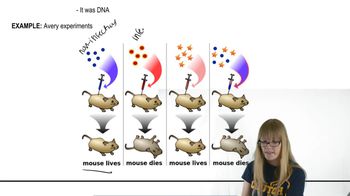
span>Step 1: Understand the historical context of the experiment. Avery, MacLeod, and McCarty were building on Griffith's experiment, which showed that a 'transforming principle' could transfer genetic information between bacteria.
span>Step 2: Identify the main goal of the experiment. Avery, MacLeod, and McCarty aimed to determine the chemical nature of the 'transforming principle' that Griffith had discovered.
span>Step 3: Describe the experimental setup. They used heat-killed virulent Streptococcus pneumoniae bacteria and treated them with different enzymes to degrade specific macromolecules: DNase (to degrade DNA), RNase (to degrade RNA), and protease (to degrade proteins).
span>Step 4: Analyze the results. When the DNA was degraded by DNase, the transformation did not occur, meaning the non-virulent bacteria did not become virulent. However, when RNA or proteins were degraded, transformation still occurred.
span>Step 5: Conclude the findings. The experiment demonstrated that DNA is the hereditary molecule because only the destruction of DNA prevented the transformation, indicating that DNA was responsible for carrying genetic information.

Risposta video verificata per un problema simile:

Questa soluzione video è stata consigliata dai nostri tutor come utile per risolvere questo problema.
Durata del video:
4m

Concetti chiave

Ecco i concetti essenziali che devi comprendere per rispondere correttamente alla domanda.

DNA as the Genetic Material

Avery, MacLeod, and McCarty's experiment demonstrated that DNA is the molecule responsible for heredity. They showed that when DNA from a virulent strain of bacteria was introduced to a non-virulent strain, the latter transformed into a virulent form, indicating that DNA carries the genetic instructions necessary for this transformation.
Video consigliato:
Percorso guidato
09:32
History and Experiments

In Vitro Transformation

In vitro transformation refers to the process of introducing foreign DNA into a cell in a controlled environment outside of a living organism. In their experiment, the researchers isolated DNA from pathogenic bacteria and mixed it with non-pathogenic bacteria, observing that only the DNA could induce a change, thus supporting the idea that DNA is the hereditary material.
Video consigliato:

Exclusion of RNA and Protein

Avery, MacLeod, and McCarty specifically tested the roles of RNA and protein by using enzymes that degraded these molecules before performing the transformation. Their results showed that the transformation did not occur when RNA or protein was destroyed, reinforcing the conclusion that DNA is the sole hereditary molecule responsible for the observed genetic change.
Video consigliato: