Ch. 7 - DNA Structure and Replication
Sanders - Genetic Analysis: An Integrated Approach 3rd Edition
Sanders3rd EditionGenetic Analysis: An Integrated ApproachISBN: 9780135564172Non è quello che usi tu?Cambia libro di testo
Capitolo 7, Problema 4

Explain how the Hershey and Chase experiment identified DNA as the hereditary molecule.

Guida verificata passo dopo passo
1
The Hershey and Chase experiment used bacteriophages, which are viruses that infect bacteria, to determine whether DNA or protein was the genetic material.
They labeled the DNA of the phages with radioactive phosphorus-32 (\(^{32}\text{P}\)) and the protein coat with radioactive sulfur-35 (\(^{35}\text{S}\)), as DNA contains phosphorus but not sulfur, and proteins contain sulfur but not phosphorus.
The labeled phages were allowed to infect bacteria, and then a blender was used to separate the phage coats from the bacterial cells.
After centrifugation, the bacteria formed a pellet at the bottom of the tube, while the phage coats remained in the supernatant.
They found that the radioactive phosphorus (\(^{32}\text{P}\)) was inside the bacterial cells, indicating that DNA was the material injected by the phages into the bacteria, while the radioactive sulfur (\(^{35}\text{S}\)) remained in the supernatant, indicating that proteins were not the genetic material.

Risposta video verificata per un problema simile:

Questa soluzione video è stata consigliata dai nostri tutor come utile per risolvere questo problema.
Durata del video:
4m

Concetti chiave

Ecco i concetti essenziali che devi comprendere per rispondere correttamente alla domanda.

Hershey and Chase Experiment

The Hershey and Chase experiment, conducted in 1952, utilized bacteriophages (viruses that infect bacteria) to determine whether DNA or protein was the genetic material. They labeled the DNA with radioactive phosphorus and the protein with radioactive sulfur, then tracked which component entered the bacterial cells. The results showed that only the DNA entered the cells, indicating that DNA is the hereditary molecule.
Video consigliato:
Percorso guidato
08:06
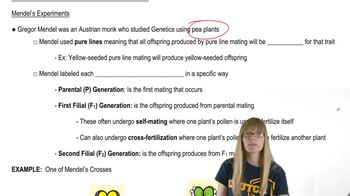
Mendel's Experiments

Bacteriophages

Bacteriophages, or phages, are viruses that specifically infect bacteria. They consist of a protein coat and genetic material, which can be either DNA or RNA. In the Hershey and Chase experiment, phages were used as a model to study the transfer of genetic information, providing a clear system to distinguish between DNA and protein as the hereditary substance.
Video consigliato:
Percorso guidato
06:04
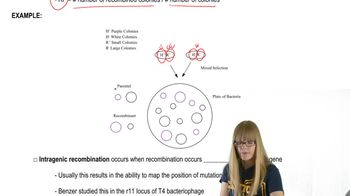
Mapping Bacteriophages

Radioactive Labeling

Radioactive labeling is a technique used to trace the movement of molecules in biological experiments. In the Hershey and Chase experiment, the researchers used radioactive isotopes to label DNA and protein separately. This allowed them to track which component was responsible for carrying genetic information into the bacterial cells, ultimately demonstrating that DNA, not protein, was the hereditary material.
Video consigliato:
Percorso guidato
02:34
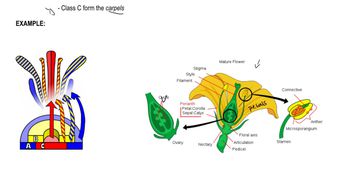
Plant HOX genes