Ch. 7 - DNA Structure and Replication
Sanders - Genetic Analysis: An Integrated Approach 3rd Edition
Sanders3rd EditionGenetic Analysis: An Integrated ApproachISBN: 9780135564172Non è quello che usi tu?Cambia libro di testo
Capitolo 7, Problema 5g

One strand of a fragment of duplex DNA has the sequence 5'-ATCGACCTGATC-3'.
Is the bond in part (f) a covalent or a noncovalent bond?

Guida verificata passo dopo passo
1
Step 1: Understand the structure of DNA. DNA is composed of two strands that form a double helix. Each strand consists of nucleotides connected by covalent bonds, specifically phosphodiester bonds between the sugar and phosphate groups.
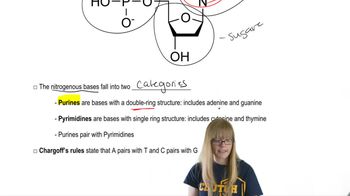
Step 2: Recognize the types of bonds in DNA. Covalent bonds are strong bonds that hold the backbone of the DNA together, while noncovalent bonds, such as hydrogen bonds, occur between complementary base pairs (A-T and G-C) to stabilize the double helix.
Step 3: Analyze the sequence provided. The sequence 5'-ATCGACCTGATC-3' represents one strand of DNA. To determine the type of bond in part (f), consider whether the bond is part of the backbone (covalent) or between base pairs (noncovalent).
Step 4: Recall that phosphodiester bonds are covalent and occur between the 3' hydroxyl group of one nucleotide and the 5' phosphate group of the next nucleotide in the strand. Hydrogen bonds, on the other hand, are noncovalent and occur between the nitrogenous bases of complementary strands.
Step 5: Based on the context of the question, identify whether the bond in part (f) is within the backbone (covalent) or between base pairs (noncovalent). Use the definitions and structural understanding of DNA to make this determination.

Risposta video verificata per un problema simile:

Questa soluzione video è stata consigliata dai nostri tutor come utile per risolvere questo problema.
Durata del video:
2m

Concetti chiave

Ecco i concetti essenziali che devi comprendere per rispondere correttamente alla domanda.

Covalent Bonds

Covalent bonds are strong chemical bonds formed when two atoms share one or more pairs of electrons. In the context of DNA, covalent bonds link the sugar and phosphate groups of the DNA backbone, creating a stable structure that holds the nucleotides together.
Video consigliato:

Noncovalent Bonds

Noncovalent bonds are weaker interactions that do not involve the sharing of electrons. In DNA, these include hydrogen bonds between complementary base pairs, which stabilize the double helix structure but allow for the strands to separate during processes like replication and transcription.
Video consigliato:

DNA Structure

DNA is composed of two strands that form a double helix, with each strand made up of nucleotides. The sequence of nucleotides encodes genetic information, and the interactions between covalent and noncovalent bonds are crucial for maintaining the integrity and functionality of the DNA molecule.
Video consigliato: