Ch. 7 - DNA Structure and Replication
Sanders - Genetic Analysis: An Integrated Approach 3rd Edition
Sanders3rd EditionGenetic Analysis: An Integrated ApproachISBN: 9780135564172Non è quello che usi tu?Cambia libro di testo
Capitolo 7, Problema 5e

One strand of a fragment of duplex DNA has the sequence 5'-ATCGACCTGATC-3'.
What enzymes catalyze the reaction in part (d)?

Guida verificata passo dopo passo
1
Understand the context of the problem: The sequence provided represents a single strand of DNA, and the question asks about enzymes involved in a specific reaction (part d). Typically, DNA-related reactions involve enzymes such as DNA polymerase, helicase, ligase, or restriction enzymes, depending on the process being studied.
Identify the type of reaction in part (d): If part (d) involves DNA replication, the enzyme DNA polymerase would be responsible for synthesizing the complementary strand. If it involves DNA repair, enzymes like DNA ligase or endonucleases might be involved. If it involves cutting the DNA, restriction enzymes would be relevant.
Consider the sequence provided: The sequence 5'-ATCGACCTGATC-3' is a single strand. If the reaction involves creating a complementary strand, DNA polymerase would catalyze the addition of nucleotides complementary to this sequence (e.g., 3'-TAGCTGGACTAG-5').
If the reaction involves joining DNA fragments, DNA ligase would catalyze the formation of phosphodiester bonds between adjacent nucleotides to seal nicks in the DNA backbone.
If the reaction involves cutting the DNA at specific sites, restriction enzymes would recognize specific palindromic sequences within the DNA and catalyze the cleavage at those sites.

Risposta video verificata per un problema simile:

Questa soluzione video è stata consigliata dai nostri tutor come utile per risolvere questo problema.
Durata del video:
2m

Concetti chiave

Ecco i concetti essenziali che devi comprendere per rispondere correttamente alla domanda.

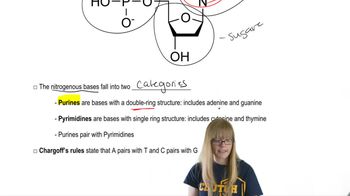
DNA Structure

DNA is composed of two strands forming a double helix, with each strand made up of nucleotides. Each nucleotide consists of a phosphate group, a sugar (deoxyribose), and a nitrogenous base (adenine, thymine, cytosine, or guanine). The sequence of these bases encodes genetic information, and the strands are complementary, meaning that adenine pairs with thymine and cytosine pairs with guanine.
Video consigliato:

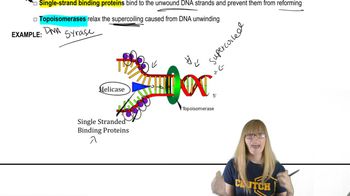
Enzymes in DNA Replication

During DNA replication, several key enzymes are involved. DNA helicase unwinds the double helix, while DNA polymerase synthesizes new strands by adding nucleotides complementary to the template strand. Additionally, ligase is responsible for joining Okazaki fragments on the lagging strand, ensuring the integrity of the newly formed DNA.
Video consigliato:
Percorso guidato
11:59
Steps to DNA Replication

Transcription and Translation

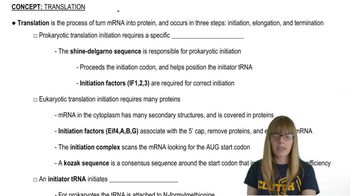
Transcription is the process by which the DNA sequence is copied into messenger RNA (mRNA), which then serves as a template for translation. During translation, ribosomes read the mRNA sequence to synthesize proteins by linking amino acids in the order specified by the mRNA. Understanding these processes is crucial for grasping how genetic information is expressed and utilized in cells.
Video consigliato:
Percorso guidato
07:58
Translation initiation