Ch. 8 - Molecular Biology of Transcription and RNA Processing
Sanders - Genetic Analysis: An Integrated Approach 3rd Edition
Sanders3rd EditionGenetic Analysis: An Integrated ApproachISBN: 9780135564172Non è quello che usi tu?Cambia libro di testo
Capitolo 8, Problema 9

Describe the two types of transcription termination found in bacterial genes. How does transcription termination differ for eukaryotic genes?

Guida verificata passo dopo passo
1
Identify the two types of transcription termination in bacterial genes: Rho-dependent and Rho-independent termination.
Explain Rho-independent termination: This involves the formation of a hairpin structure in the RNA transcript followed by a series of uracil residues, which destabilizes the RNA-DNA hybrid and causes the RNA polymerase to dissociate.
Describe Rho-dependent termination: This requires the Rho protein, which binds to the RNA transcript and moves towards the RNA polymerase, causing it to dissociate from the DNA when it reaches a specific termination site.
Discuss transcription termination in eukaryotic genes: Eukaryotic termination involves the cleavage of the pre-mRNA and the addition of a poly-A tail, which is facilitated by specific sequences and protein factors.
Highlight the differences: Unlike bacteria, eukaryotic termination does not rely on hairpin structures or Rho proteins, and involves more complex processing of the pre-mRNA.

Risposta video verificata per un problema simile:

Questa soluzione video è stata consigliata dai nostri tutor come utile per risolvere questo problema.
Durata del video:
4m

Concetti chiave

Ecco i concetti essenziali che devi comprendere per rispondere correttamente alla domanda.

Transcription Termination in Bacteria

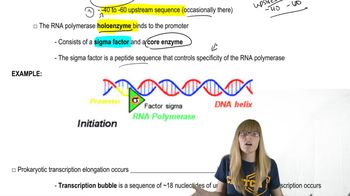
In bacteria, transcription termination occurs primarily through two mechanisms: Rho-dependent and Rho-independent termination. Rho-dependent termination involves the Rho protein binding to the RNA transcript and moving along it to catch up with the RNA polymerase, causing it to dissociate. Rho-independent termination relies on the formation of a hairpin loop in the RNA followed by a series of uracil residues, which destabilizes the RNA-DNA hybrid and leads to termination.
Video consigliato:
Percorso guidato
10:14
Prokaryotic Transcription

Eukaryotic Transcription Termination

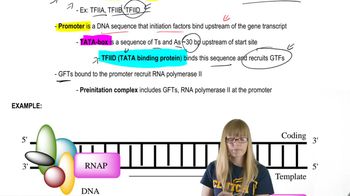
Eukaryotic transcription termination is more complex than in bacteria and involves several factors, including the cleavage of the RNA transcript and the addition of a poly-A tail. After RNA polymerase II transcribes a gene, it continues to elongate until it encounters a polyadenylation signal, which triggers the cleavage of the RNA and the addition of adenine nucleotides. This process is coupled with the release of the RNA polymerase from the DNA template.
Video consigliato:
Percorso guidato
09:16
Eukaryotic Transcription

Differences Between Prokaryotic and Eukaryotic Termination

The key differences between transcription termination in prokaryotes and eukaryotes lie in the mechanisms and complexity involved. Prokaryotic termination is generally simpler and can occur co-transcriptionally, while eukaryotic termination involves additional processing steps, such as RNA cleavage and polyadenylation. Furthermore, eukaryotic transcription occurs in the nucleus, requiring additional regulatory mechanisms to ensure proper gene expression.
Video consigliato:
Percorso guidato
10:14
Prokaryotic Transcription
Pratica correlata