Ch. 9 - The Molecular Biology of Translation
Sanders - Genetic Analysis: An Integrated Approach 3rd Edition
Sanders3rd EditionGenetic Analysis: An Integrated ApproachISBN: 9780135564172Non è quello che usi tu?Cambia libro di testo
Capitolo 9, Problema 5a

A portion of a DNA template strand has the base sequence
5′-...ACGCGATGCGTGATGTATAGAGCT...-3′
Identify the sequence and polarity of the mRNA transcribed from this fragmentary template-strand sequence.

Guida verificata passo dopo passo
1
Understand that transcription involves synthesizing an mRNA strand complementary to the DNA template strand, with uracil (U) replacing thymine (T) in RNA.
Identify the polarity of the DNA template strand provided: 5′-ACGCGATGCGTGATGTATAGAGCT-3′. The mRNA will be synthesized in the 5′ to 3′ direction, complementary to the DNA template strand.
Write the complementary base pairing rules: Adenine (A) pairs with Uracil (U) in RNA, Cytosine (C) pairs with Guanine (G), Guanine (G) pairs with Cytosine (C), and Thymine (T) pairs with Adenine (A).
Apply the base pairing rules to the DNA template strand to determine the mRNA sequence. For example, the first base in the DNA template strand (A) will pair with U in the mRNA, the second base (C) will pair with G, and so on.
Ensure the polarity of the mRNA sequence is 5′ to 3′, as RNA polymerase synthesizes mRNA in this direction. The resulting mRNA sequence will be complementary to the DNA template strand and match the coding strand (non-template strand) except for the substitution of U for T.

Risposta video verificata per un problema simile:

Questa soluzione video è stata consigliata dai nostri tutor come utile per risolvere questo problema.
Durata del video:
3m

Concetti chiave

Ecco i concetti essenziali che devi comprendere per rispondere correttamente alla domanda.

Transcription

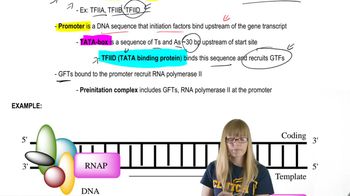
Transcription is the process by which the genetic information encoded in DNA is copied into messenger RNA (mRNA). During transcription, RNA polymerase binds to the DNA template strand and synthesizes a complementary RNA strand by pairing RNA nucleotides with the DNA bases, following the base-pairing rules (A-U and C-G). This process occurs in the nucleus of eukaryotic cells.
Video consigliato:
Percorso guidato
09:16
Eukaryotic Transcription

Polarity of Nucleic Acids

Nucleic acids, including DNA and RNA, have directionality, often referred to as polarity, which is indicated by the 5' and 3' ends. The 5' end has a phosphate group, while the 3' end has a hydroxyl group. During transcription, RNA is synthesized in the 5' to 3' direction, meaning that the RNA strand grows by adding nucleotides to the 3' end, complementary to the 3' to 5' direction of the DNA template.
Video consigliato:
Percorso guidato
09:49
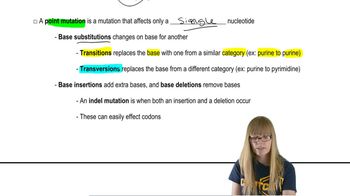
Point Mutations

Base Pairing Rules

Base pairing rules dictate how nucleotides pair with each other during the processes of DNA replication and transcription. In RNA, adenine (A) pairs with uracil (U) instead of thymine (T), which is found in DNA. Cytosine (C) pairs with guanine (G) in both DNA and RNA. Understanding these rules is essential for determining the correct mRNA sequence transcribed from a given DNA template.
Video consigliato:
Percorso guidato
03:49
Base Distortions