Ch. 9 - The Molecular Biology of Translation
Sanders - Genetic Analysis: An Integrated Approach 3rd Edition
Sanders3rd EditionGenetic Analysis: An Integrated ApproachISBN: 9780135564172Non è quello che usi tu?Cambia libro di testo
Capitolo 9, Problema 5b

A portion of a DNA template strand has the base sequence
5′-...ACGCGATGCGTGATGTATAGAGCT...-3′
Assume the mRNA is written in the correct reading frame. Determine the amino acid sequence encoded by this fragment. Identify the N- and C-terminal directions of the polypeptide.

Guida verificata passo dopo passo
1
Step 1: Identify the complementary mRNA sequence by transcribing the DNA template strand. Remember that RNA uses uracil (U) instead of thymine (T). The DNA template strand is read in the 3′ to 5′ direction, so the mRNA will be synthesized in the 5′ to 3′ direction. For example, A pairs with U, C pairs with G, G pairs with C, and T pairs with A.
Step 2: Divide the mRNA sequence into codons (groups of three nucleotides). Each codon corresponds to a specific amino acid or a stop signal during translation.
Step 3: Use the genetic code table to translate each codon into its corresponding amino acid. For example, AUG codes for methionine (start codon), and UAA, UAG, or UGA are stop codons.
Step 4: Determine the directionality of the polypeptide chain. Translation begins at the N-terminal (amino group) and proceeds toward the C-terminal (carboxyl group). The first amino acid corresponds to the start codon, and the sequence ends at the stop codon.
Step 5: Write out the amino acid sequence in order, starting from the N-terminal and ending at the C-terminal. Ensure that you include the start codon and stop translation at the stop codon.

Risposta video verificata per un problema simile:

Questa soluzione video è stata consigliata dai nostri tutor come utile per risolvere questo problema.
Durata del video:
2m

Concetti chiave

Ecco i concetti essenziali che devi comprendere per rispondere correttamente alla domanda.

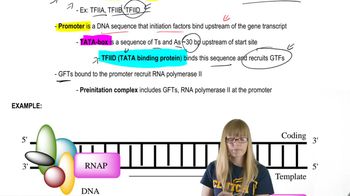
Transcription

Transcription is the process by which the genetic information in DNA is copied into messenger RNA (mRNA). During this process, RNA polymerase binds to the DNA template strand and synthesizes a complementary RNA strand, replacing thymine (T) with uracil (U). Understanding transcription is essential for determining how the DNA sequence translates into an mRNA sequence, which is the first step in protein synthesis.
Video consigliato:
Percorso guidato
09:16
Eukaryotic Transcription

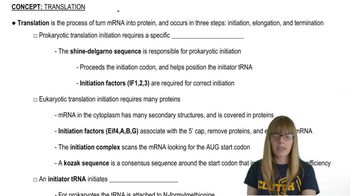
Translation

Translation is the process by which the mRNA sequence is decoded to synthesize a polypeptide chain, which will fold into a functional protein. This occurs in the ribosome, where transfer RNA (tRNA) molecules bring specific amino acids to the growing polypeptide chain based on the codon sequence of the mRNA. Recognizing how codons correspond to amino acids is crucial for determining the final amino acid sequence from the mRNA.
Video consigliato:
Percorso guidato
07:58
Translation initiation

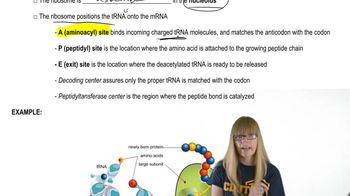
Amino Acid Structure and Polypeptide Directionality

Amino acids are the building blocks of proteins, each consisting of a central carbon atom, an amino group, a carboxyl group, and a variable R group that determines the specific properties of the amino acid. In a polypeptide chain, the N-terminus refers to the end with a free amino group, while the C-terminus has a free carboxyl group. Understanding this directionality is important for correctly identifying the ends of the synthesized polypeptide and its functional implications.
Video consigliato:
Percorso guidato
03:49
Ribosome Structure
Pratica correlata
Domanda del libro di testo

Describe the gene and protein defects in phenylketonuria (PKU). How are these defects connected to disease symptoms?

430
views
Domanda del libro di testo

Describe three features of tRNA molecules that lead to their correct charging by tRNA synthetase enzymes.

1365
views
Domanda del libro di testo

Outline the events that occur during initiation of translation in E. coli.

627
views
Domanda del libro di testo

A couple and some of their relatives are screened for Gaucher disease in a community-based screening program. The woman is homozygous for the dominant allele, represented by G. The woman's father, sister, and paternal grandmother are heterozygous carriers of the mutant allele, represented by g. Her paternal grandfather, her mother, and both of her mother's parents are homozygous for the dominant allele. The man is heterozygous and he has a brother with Gaucher disease. The man's parents and grandparents have not been tested, but it is known that none of them has Gaucher disease.

Explain why you are able to assign genotypes to the man's parents despite their not being tested.

388
views
Domanda del libro di testo

A portion of a DNA template strand has the base sequence

5′-...ACGCGATGCGTGATGTATAGAGCT...-3′

Which is the third amino acid added to the polypeptide chain?

651
views
Domanda del libro di testo

A portion of a DNA template strand has the base sequence

5′-...ACGCGATGCGTGATGTATAGAGCT...-3′

Identify the sequence and polarity of the mRNA transcribed from this fragmentary template-strand sequence.

797
views