Glucose, a form of sugar, has the formula C6H12O6. Which elements are included in this compound, and how many atoms of each are present?
Ch.1 Matter and Measurements
McMurry8th EditionFundamentals of General, Organic, and Biological ChemistryISBN: 9780134015187Non è quello che usi tu?Cambia libro di testo
Capitolo 1, Problema 56
Give the full name of the following units:
a. cc
b. dm
c. mm
d. nL
e. mg
f. m3
Guida verificata passo dopo passo1
Step 1: Understand that the question is asking for the full names of the given units, which are abbreviations commonly used in scientific measurements.
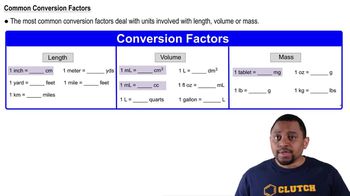
Step 2: For 'cc', recognize that it stands for 'cubic centimeter', a unit of volume equivalent to 1 milliliter (mL).
Step 3: For 'dm', identify it as 'decimeter', which is a unit of length equal to one-tenth of a meter (10⁻¹ m).
Step 4: For 'mm', determine that it represents 'millimeter', a unit of length equal to one-thousandth of a meter (10⁻³ m).
Step 5: For 'nL', 'mg', and 'm³', recognize that they stand for 'nanoliter' (10⁻⁹ liters), 'milligram' (10⁻³ grams), and 'cubic meter' (a unit of volume), respectively.

Risposta video verificata per un problema simile:
Questa soluzione video è stata consigliata dai nostri tutor come utile per risolvere questo problema.
Durata del video:
2mConcetti chiave
Ecco i concetti essenziali che devi comprendere per rispondere correttamente alla domanda.
Centicenti (cc)
The unit 'cc' stands for cubic centimeter, which is a volume measurement equivalent to one milliliter. It is commonly used in fields such as medicine and science to quantify liquid volumes. One cubic centimeter is defined as the volume of a cube with sides of one centimeter.
Video consigliato:
Percorso guidato
Conversion Factors (Simplified) Concept 2
Decimeter (dm)
The unit 'dm' refers to decimeter, a metric unit of length equal to one-tenth of a meter. It is often used in contexts where measurements are needed in a more manageable scale than meters, such as in education and everyday measurements. One decimeter is equivalent to 10 centimeters.
Video consigliato:
Percorso guidato
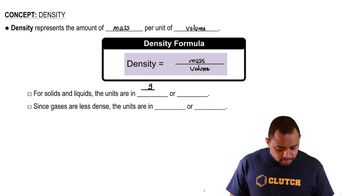
Density
Milligram (mg)
The unit 'mg' stands for milligram, which is a metric unit of mass equal to one-thousandth of a gram. It is frequently used in fields like pharmacology and nutrition to measure small quantities of substances. Understanding milligrams is essential for accurate dosing and nutritional information.
Video consigliato:
Percorso guidato
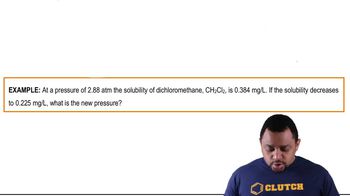
Henry's Law Calculations Example 2
Pratica correlata
Domanda del libro di testo
3710
views
Domanda del libro di testo
The white blood cell concentration in normal blood is approximately 12,000 cells/mm3 of blood. How many white blood cells does a normal adult with 5 L of blood have? Express the answer in scientific notation.
2238
views
1
rank
Domanda del libro di testo
The specific heat of fat is 0.45 cal/(g ⋅ °C) (1.9 J/g °C) and the density of fat is 0.94 g/cm3. How much energy (in calories and joules) is needed to heat 10 cm3 of fat from room temperature (25 °C) to its melting point (35 °C)?
3117
views
1
rank
Domanda del libro di testo
What is the difference between a physical quantity and a number?
3593
views
Domanda del libro di testo
Calculate the specific heat of copper if it takes 23 cal (96 J) to heat a 5.0 g sample from 25 °C to 75 °C.
2266
views
Domanda del libro di testo
Write the formula for ibuprofen: 13 carbons, 18 hydrogens, and 2 oxygens. What are the common uses of ibuprofen?
2832
views