Ch.12 Introduction to Organic Chemistry: Alkanes
McMurry - Fundamentals of General, Organic, and Biological Chemistry 8th Edition
McMurry8th EditionFundamentals of General, Organic, and Biological ChemistryISBN: 9780134015187Non è quello che usi tu?Cambia libro di testo
Capitolo 12, Problema 23b

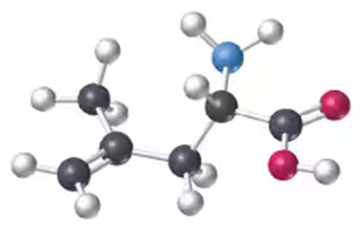
Convert the following models into line drawings and identify the functional groups in each:
b.

Guida verificata passo dopo passo
1
Examine the given molecular models carefully. Identify the atoms (e.g., carbon, hydrogen, oxygen, nitrogen) and their connectivity to understand the structure of the molecule.
Convert the molecular model into a line drawing. In a line drawing, carbon atoms are represented by the ends and intersections of lines, and hydrogen atoms bonded to carbon are typically omitted for simplicity. Non-carbon atoms (e.g., oxygen, nitrogen) and their attached hydrogens must be explicitly shown.
Identify any functional groups present in the molecule. Functional groups are specific groups of atoms within molecules that determine the chemical properties of the compound. Common functional groups include hydroxyl (-OH), carbonyl (C=O), carboxyl (-COOH), amino (-NH2), and others.
Label the functional groups in the line drawing. For example, if you see a -OH group attached to a carbon, label it as a hydroxyl group. If there is a double bond between carbon and oxygen, label it as a carbonyl group.
Double-check your line drawing and functional group identification to ensure accuracy. Verify that all atoms and bonds from the molecular model are correctly represented in the line drawing and that all functional groups are properly identified.

Risposta video verificata per un problema simile:

Questa soluzione video è stata consigliata dai nostri tutor come utile per risolvere questo problema.

Concetti chiave

Ecco i concetti essenziali che devi comprendere per rispondere correttamente alla domanda.

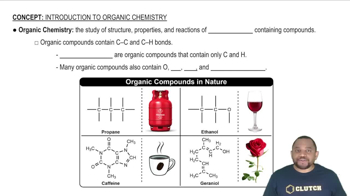
Line Drawings in Organic Chemistry

Line drawings, or skeletal structures, are simplified representations of organic molecules where carbon atoms are implied at the ends and intersections of lines. This method emphasizes the connectivity of atoms and functional groups while omitting hydrogen atoms attached to carbons, making it easier to visualize complex structures.
Video consigliato:
Percorso guidato
2:26
Introduction to Organic Chemistry Concept 1

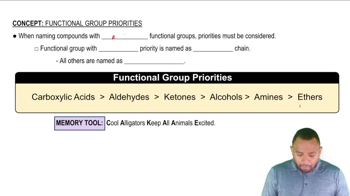
Functional Groups

Functional groups are specific groups of atoms within molecules that are responsible for the characteristic chemical reactions of those molecules. Common functional groups include hydroxyl (-OH), carboxyl (-COOH), and amino (-NH2) groups, each imparting distinct properties and reactivity to the compounds they are part of.
Video consigliato:
Percorso guidato
1:11
Functional Group Priorities Concept 1

Molecular Structure Interpretation

Interpreting molecular structures involves analyzing the arrangement of atoms and the types of bonds present in a molecule. Understanding how to identify and differentiate between various functional groups is crucial for predicting the behavior and reactivity of organic compounds in chemical reactions.
Video consigliato:
Percorso guidato
00:34
Molecular Models Example 1