Ch.12 Introduction to Organic Chemistry: Alkanes
McMurry - Fundamentals of General, Organic, and Biological Chemistry 8th Edition
McMurry8th EditionFundamentals of General, Organic, and Biological ChemistryISBN: 9780134015187Non è quello che usi tu?Cambia libro di testo
Capitolo 12, Problema 24a

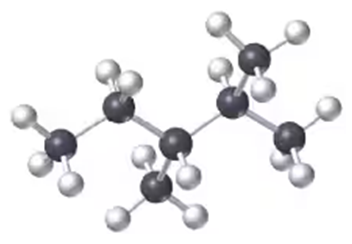
Give the IUPAC names for the following alkanes:
a.

Guida verificata passo dopo passo
1
Identify the longest continuous carbon chain in the structure. This chain determines the base name of the alkane (e.g., methane, ethane, propane, etc.).
Number the carbon atoms in the longest chain starting from the end nearest to the first substituent group. This ensures the substituents have the lowest possible numbers.
Identify and name all substituent groups attached to the main chain. Substituents are alkyl groups (e.g., methyl, ethyl, propyl) or other functional groups.
Combine the names of the substituents with the base name of the alkane. Use prefixes (di-, tri-, tetra-, etc.) if there are multiple identical substituents, and list substituents in alphabetical order.
Write the final IUPAC name by placing the substituent names (with their position numbers) before the base name of the alkane, separated by hyphens. Ensure proper punctuation and formatting.

Risposta video verificata per un problema simile:

Questa soluzione video è stata consigliata dai nostri tutor come utile per risolvere questo problema.

Concetti chiave

Ecco i concetti essenziali che devi comprendere per rispondere correttamente alla domanda.

IUPAC Nomenclature

IUPAC nomenclature is a systematic method for naming chemical compounds, particularly organic molecules. It provides a set of rules to derive names based on the structure of the compound, ensuring that each name is unique and informative. For alkanes, the names are derived from the longest continuous carbon chain, with suffixes indicating the type of compound.
Video consigliato:
Percorso guidato
3:18
IUPAC Naming Concept 3

Alkanes

Alkanes are a class of hydrocarbons characterized by single bonds between carbon atoms and the general formula CnH2n+2. They are saturated compounds, meaning they contain the maximum number of hydrogen atoms per carbon atom. Alkanes are typically non-polar and exhibit low reactivity, making them important in various chemical processes and applications.
Video consigliato:
Percorso guidato
1:20
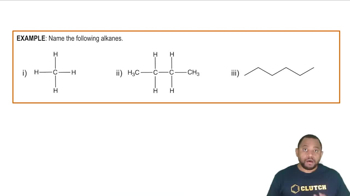
Naming Alkanes Example 1

Longest Carbon Chain

Identifying the longest carbon chain is crucial in naming alkanes according to IUPAC rules. The longest chain serves as the backbone of the molecule, and its length determines the base name of the alkane (e.g., methane, ethane, propane). Branches or substituents are then named and numbered based on their position relative to the longest chain, ensuring clarity in the compound's structure.
Video consigliato:
Percorso guidato
1:43
Intro to Electron Transport Chain Example 1