Ch.12 Introduction to Organic Chemistry: Alkanes
McMurry - Fundamentals of General, Organic, and Biological Chemistry 8th Edition
McMurry8th EditionFundamentals of General, Organic, and Biological ChemistryISBN: 9780134015187Non è quello che usi tu?Cambia libro di testo
Capitolo 12, Problema 69a

When pentane is exposed to Br2 in the presence of light, a halogenation reaction occurs. Write the formulas of:
a. All possible products containing only one bromine

Guida verificata passo dopo passo
1
Step 1: Understand the reaction type. This is a halogenation reaction, specifically a free radical substitution reaction, where bromine (Br₂) reacts with pentane (C₅H₁₂) in the presence of light to replace one hydrogen atom with a bromine atom.
Step 2: Identify the structure of pentane. Pentane is a straight-chain alkane with the molecular formula C₅H₁₂. Its structure consists of five carbon atoms connected in a chain, with each carbon bonded to enough hydrogen atoms to satisfy the octet rule.
Step 3: Determine the possible positions for bromine substitution. In pentane, there are three unique types of hydrogen atoms based on their positions: primary (attached to a terminal carbon), secondary (attached to a carbon bonded to two other carbons), and tertiary (not present in pentane). Bromine can replace any of these hydrogens, leading to different products.
Step 4: Write the structural formulas for all possible monobrominated products. These include: 1-bromopentane (Br attached to the first carbon), 2-bromopentane (Br attached to the second carbon), and 3-bromopentane (Br attached to the third carbon). Note that 4-bromopentane and 5-bromopentane are identical to 1-bromopentane due to symmetry.
Step 5: Verify the uniqueness of each product. Ensure that no two products are identical by considering the symmetry of the pentane molecule. The final list of products should include only unique structures: 1-bromopentane, 2-bromopentane, and 3-bromopentane.

Concetti chiave

Ecco i concetti essenziali che devi comprendere per rispondere correttamente alla domanda.

Halogenation Reaction

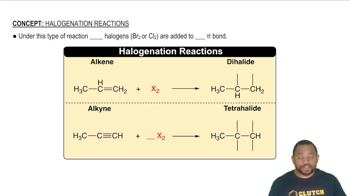
Halogenation is a chemical reaction where a halogen atom, such as bromine (Br₂), is introduced into a compound. In the case of alkanes like pentane, this reaction typically occurs via a free radical mechanism, initiated by light or heat, leading to the substitution of hydrogen atoms with halogen atoms. Understanding this process is crucial for predicting the products formed when pentane reacts with bromine.
Video consigliato:
Percorso guidato
1:11
Halogenation Reactions Concept 1

Free Radical Mechanism

The free radical mechanism involves the formation of highly reactive species known as free radicals, which have unpaired electrons. In the halogenation of pentane, light energy causes the Br-Br bond to break, generating bromine radicals. These radicals then react with pentane, abstracting hydrogen atoms and forming new brominated products. This mechanism is essential for understanding how specific products are formed in halogenation reactions.
Video consigliato:
Percorso guidato
01:04
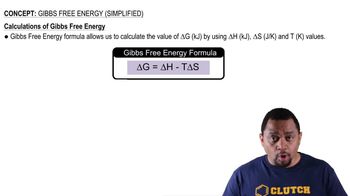
Gibbs Free Energy (Simplified) Concept 3

Structural Isomers

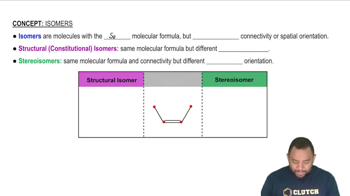
Structural isomers are compounds that have the same molecular formula but different arrangements of atoms. In the case of brominated pentane, the presence of one bromine atom can lead to multiple structural isomers, depending on which hydrogen atom is replaced. Recognizing these isomers is important for accurately writing the formulas of all possible products resulting from the halogenation of pentane.
Video consigliato:
Percorso guidato
2:16
Isomers Concept 1