Ch.18 Amino Acids and Proteins
McMurry - Fundamentals of General, Organic, and Biological Chemistry 8th Edition
McMurry8th EditionFundamentals of General, Organic, and Biological ChemistryISBN: 9780134015187Non è quello che usi tu?Cambia libro di testo
Capitolo 18, Problema 68b

Bradykinin, a peptide that helps to regulate blood pressure, has the primary structure Arg-Pro-Pro-Gly-Phe-Ser-Pro-Phe-Arg.
b. Bradykinin has a very kinked secondary structure. Why?

Guida verificata passo dopo passo
1
Understand the primary structure of bradykinin: The primary structure refers to the sequence of amino acids in the peptide chain. In this case, the sequence is Arg-Pro-Pro-Gly-Phe-Ser-Pro-Phe-Arg.
Recognize the role of proline in the peptide chain: Proline is a unique amino acid because its side chain forms a cyclic structure that connects back to the amino group. This restricts the rotation around the peptide bond and introduces kinks or bends in the peptide chain.
Identify the positions of proline in the sequence: In bradykinin, proline appears at positions 2, 3, and 7. The presence of multiple proline residues contributes significantly to the kinked structure of the peptide.
Consider the flexibility of glycine: Glycine, found at position 4, is the smallest amino acid and provides flexibility to the peptide chain. This flexibility can further influence the overall secondary structure.
Conclude the secondary structure: The combination of proline-induced kinks and glycine's flexibility results in a very kinked and irregular secondary structure for bradykinin, which is important for its biological function.

Risposta video verificata per un problema simile:

Questa soluzione video è stata consigliata dai nostri tutor come utile per risolvere questo problema.

Concetti chiave

Ecco i concetti essenziali che devi comprendere per rispondere correttamente alla domanda.

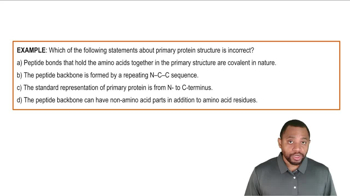
Primary Structure of Proteins

The primary structure of a protein refers to its unique sequence of amino acids, which determines its overall shape and function. In the case of bradykinin, the sequence Arg-Pro-Pro-Gly-Phe-Ser-Pro-Phe-Arg is crucial for its biological activity. The specific arrangement of these amino acids influences how the peptide interacts with receptors and other molecules in the body.
Video consigliato:
Percorso guidato
1:11
Primary Protein Structure Example 1

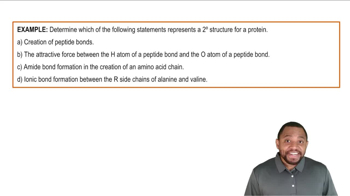
Secondary Structure of Proteins

The secondary structure of proteins refers to the local folded structures that form within a protein due to hydrogen bonding between the backbone atoms. Common secondary structures include alpha helices and beta sheets. In bradykinin, the presence of proline residues can introduce kinks and disrupt regular hydrogen bonding patterns, leading to a kinked or irregular secondary structure.
Video consigliato:
Percorso guidato
1:24
Secondary Protein Structure Example 2

Role of Proline in Protein Structure

Proline is an amino acid known for its unique cyclic structure, which restricts the rotation around the peptide bond. This rigidity can introduce bends or kinks in the polypeptide chain, affecting the overall conformation of the protein. In bradykinin, the presence of multiple proline residues contributes to its kinked secondary structure, impacting its biological function and interaction with receptors.
Video consigliato:
Percorso guidato
3:26
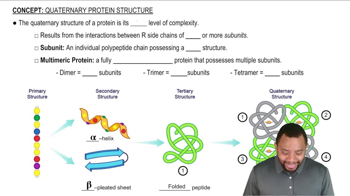
Quaternary Protein Structure Concept 1