Ch.18 Amino Acids and Proteins
McMurry - Fundamentals of General, Organic, and Biological Chemistry 8th Edition
McMurry8th EditionFundamentals of General, Organic, and Biological ChemistryISBN: 9780134015187Non è quello che usi tu?Cambia libro di testo
Capitolo 18, Problema 67

What is the sequence of atoms along the "backbone" of a protein?

Guida verificata passo dopo passo
1
Understand that the 'backbone' of a protein refers to the repeating sequence of atoms that form the main structural framework of the protein, excluding the side chains (R groups).
Recall that proteins are polymers made up of amino acids linked together by peptide bonds. Each amino acid consists of an amine group (-NH₂), a carboxyl group (-COOH), a hydrogen atom, and a variable side chain (R group) attached to a central carbon atom (the alpha carbon).
When amino acids link together to form a protein, the carboxyl group of one amino acid reacts with the amine group of another, forming a peptide bond and releasing a molecule of water (a condensation reaction).
The resulting backbone of the protein consists of a repeating sequence of atoms: -N-C-C-. Specifically, this sequence includes the nitrogen atom from the amine group, the alpha carbon atom, and the carbon atom from the carboxyl group of each amino acid.
This -N-C-C- sequence repeats throughout the length of the protein, forming the structural backbone, while the side chains (R groups) extend outward from the alpha carbon atoms, giving the protein its unique properties and functions.

Risposta video verificata per un problema simile:

Questa soluzione video è stata consigliata dai nostri tutor come utile per risolvere questo problema.

Concetti chiave

Ecco i concetti essenziali che devi comprendere per rispondere correttamente alla domanda.

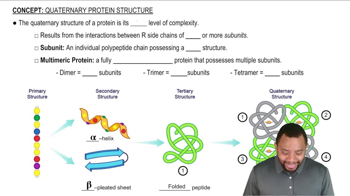
Protein Structure

Proteins are complex molecules made up of amino acids, which are linked together in a specific sequence. The structure of a protein is crucial for its function, and it typically consists of four levels: primary, secondary, tertiary, and quaternary. The primary structure refers to the linear sequence of amino acids that form the protein's backbone.
Video consigliato:
Percorso guidato
3:26
Quaternary Protein Structure Concept 1

Amino Acids

Amino acids are the building blocks of proteins, each containing an amino group, a carboxyl group, and a unique side chain. There are 20 standard amino acids, and their specific sequence determines the protein's structure and function. The backbone of a protein is formed by the peptide bonds between the amino acids, linking them in a chain.
Video consigliato:
Percorso guidato
3:03
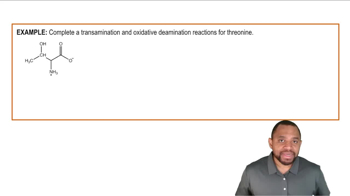
Amino Acid Catabolism: Amino Group Example 2

Peptide Bonds

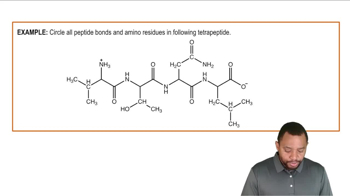
Peptide bonds are covalent bonds that link amino acids together in a protein. They form through a dehydration reaction, where the carboxyl group of one amino acid reacts with the amino group of another, releasing a molecule of water. This bond creates the backbone of the protein, which is essential for maintaining its structural integrity and function.
Video consigliato:
Percorso guidato
1:24
Peptides Example 1