Ch.19 Enzymes and Vitamins
McMurry - Fundamentals of General, Organic, and Biological Chemistry 8th Edition
McMurry8th EditionFundamentals of General, Organic, and Biological ChemistryISBN: 9780134015187Non è quello che usi tu?Cambia libro di testo
Capitolo 19, Problema 30a

What type of enzyme regulation occurs in the following situations?
a. Buildup of the product of the pathway that converts glucose to pyruvate stops at the first enzyme in the multistep process.

Guida verificata passo dopo passo
1
Step 1: Understand the context of the problem. The question is asking about enzyme regulation, specifically in a metabolic pathway where glucose is converted to pyruvate. This is a multistep process involving several enzymes.
Step 2: Recall the concept of feedback inhibition. Feedback inhibition is a type of enzyme regulation where the end product of a metabolic pathway inhibits an enzyme that acts earlier in the pathway. This prevents the overproduction of the product.
Step 3: Identify the specific situation described. The problem states that the buildup of the product stops the first enzyme in the pathway. This is a classic example of feedback inhibition, where the product acts as an allosteric inhibitor.
Step 4: Explain how feedback inhibition works. In this type of regulation, the product binds to a regulatory site (not the active site) on the enzyme, causing a conformational change that reduces the enzyme's activity. This ensures that the pathway is regulated based on the cell's needs.
Step 5: Conclude that the type of enzyme regulation described in this situation is feedback inhibition, which is a common mechanism for controlling metabolic pathways.

Risposta video verificata per un problema simile:

Questa soluzione video è stata consigliata dai nostri tutor come utile per risolvere questo problema.
Durata del video:
4m

Concetti chiave

Ecco i concetti essenziali che devi comprendere per rispondere correttamente alla domanda.

Feedback Inhibition

Feedback inhibition is a regulatory mechanism in metabolic pathways where the accumulation of an end product inhibits an earlier step in the pathway. In this case, when the product of the glucose to pyruvate conversion builds up, it signals the first enzyme to slow down or stop its activity, preventing overproduction and maintaining homeostasis.
Video consigliato:
Percorso guidato
1:19
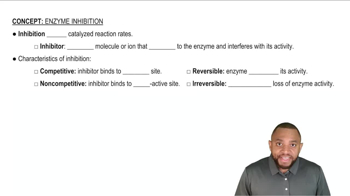
Enzyme Inhibition Concept 1

Enzyme Kinetics

Enzyme kinetics studies the rates of enzyme-catalyzed reactions and how they change in response to various factors, including substrate concentration and product levels. Understanding enzyme kinetics is crucial for analyzing how feedback inhibition affects the overall rate of a metabolic pathway, particularly in multistep processes.
Video consigliato:
Percorso guidato
01:19
Kinetic Molecular Theory Concept 1

Allosteric Regulation

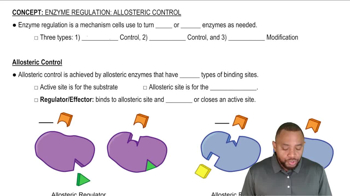
Allosteric regulation involves the binding of regulatory molecules to an enzyme at sites other than the active site, leading to conformational changes that affect enzyme activity. In the context of feedback inhibition, the end product may act as an allosteric inhibitor, altering the enzyme's shape and reducing its activity, thereby controlling the flow of metabolites through the pathway.
Video consigliato:
Percorso guidato
2:57
Allosteric Control Concept 1