Ch.19 Enzymes and Vitamins
McMurry - Fundamentals of General, Organic, and Biological Chemistry 8th Edition
McMurry8th EditionFundamentals of General, Organic, and Biological ChemistryISBN: 9780134015187Non è quello che usi tu?Cambia libro di testo
Capitolo 19, Problema 30d

What type of enzyme regulation occurs in the following situations?
d. Conversion of isocitrate to α-ketoglutarate is inhibited by high levels of ATP. (Hint: ATP is neither a product nor a substrate in this reaction.)

Guida verificata passo dopo passo
1
Identify the type of enzyme regulation by analyzing the role of ATP in the reaction. Since ATP is neither a product nor a substrate, it is acting as an allosteric effector.
Understand that allosteric regulation occurs when a molecule binds to a site on the enzyme other than the active site, causing a change in the enzyme's activity.
Recognize that ATP is acting as an allosteric inhibitor in this case because high levels of ATP inhibit the conversion of isocitrate to α-ketoglutarate.
Recall that this type of regulation is often part of feedback inhibition, where the accumulation of a product (in this case, ATP) signals the enzyme to slow down or stop its activity to maintain balance in the metabolic pathway.
Conclude that the type of enzyme regulation occurring here is allosteric inhibition, specifically as part of feedback inhibition, which helps regulate energy production in the cell.

Risposta video verificata per un problema simile:

Questa soluzione video è stata consigliata dai nostri tutor come utile per risolvere questo problema.
Durata del video:
2m

Concetti chiave

Ecco i concetti essenziali che devi comprendere per rispondere correttamente alla domanda.

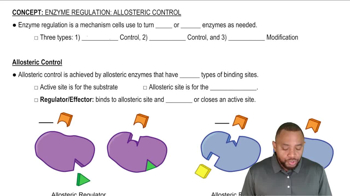
Allosteric Regulation

Allosteric regulation involves the binding of an effector molecule at a site other than the enzyme's active site, leading to a conformational change that affects enzyme activity. In the case of isocitrate to α-ketoglutarate conversion, ATP acts as an allosteric inhibitor, reducing the enzyme's activity when energy levels are high, thus preventing unnecessary energy expenditure.
Video consigliato:
Percorso guidato
2:57
Allosteric Control Concept 1

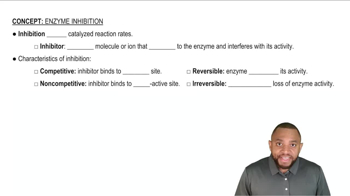
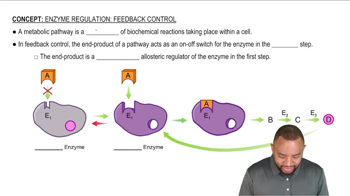
Feedback Inhibition

Feedback inhibition is a regulatory mechanism where the end product of a metabolic pathway inhibits an earlier step in the pathway. Although ATP is not a product of the isocitrate to α-ketoglutarate reaction, its high concentration signals that the cell has sufficient energy, thus inhibiting the pathway to prevent overproduction of intermediates.
Video consigliato:
Percorso guidato
1:19
Enzyme Inhibition Concept 1

Metabolic Control

Metabolic control refers to the regulation of metabolic pathways to maintain homeostasis within the cell. Enzymes are key players in this process, and their activity can be modulated by various factors, including substrate availability and allosteric effectors like ATP, ensuring that metabolic processes align with the cell's energy needs.
Video consigliato:
Percorso guidato
2:50
Feedback Control Concept 1